
AI can, and should, scale human insight
Article • 17 November 2026
It’s unsurprising that the prospect of agentic design can cause some uneasiness and surface concerns about how rapidly the discipline is changing, how to adjust, what tools are worth investing in, and what are just fads which will waste investment for a few weeks. With these in the forefront of our own minds, the ways in which we’ve incorporated agentic tooling into our own design process hasn’t been without significant consideration. Not everything feels settled yet, either. As Tom, one of our designers, puts it: “I’m not sure I’m at the design nirvana point yet. People seem to expect everything faster and cheaper and that means everything gets squeezed.” 19 years of experience in strategic design has taught us what qualifies as strong design, where human reasoning needs to be retained, and a good understanding of what you can lose and gain with automation.
Since publishing our Made by Agents framework, we’ve been more thoroughly articulating what we think the value of agents in innovation is, in parts, and beginning with design below. The implications of agentic design are twofold: they’ve changed our in-house processes (AKA how we deliver project work), and what we leave clients with.
Design and engineering were split for decades for reasons that made sense at the time: code was slow to change and hard to learn, browsers were limited, and a canvas was easier to share. Perhaps more significant than those, code was expensive — development took a large part of the investment and the wrong bet resulted in a huge wasted budget. For designers, this meant that Figma and other design tools built a separate canvas instead of using the web they were destined to end up on. Designers and engineers ended up speaking two languages (literally and metaphorically, we would argue) and handover became an arduous process where designs had to be translated, troubleshot, and later developed in code, a gap which took time, effort, and investment.
AI has now collapsed the time and cost that once defined coding — the canvas can now be production-ready code, generated by agents themselves but constrained by principles and values embedded into them by human designers. Engineers and designers are no longer necessarily siloed by the tools and languages they speak in, and the transition can theoretically be smoother, if a transition at all. For Tom, who remembers the early web, it brings something back: Flash. “Then the web grew up… frameworks, templates, best practice and design systems. It happened for good reasons… Then everything started to look the same. Working with AI tools gives me that Flash feeling again.”
That said, legacy ways of working are hard to break. The product development lifecycle has existed in such a way for years — to change it means a reevaluation of the roles of engineer and designer in an organisation. Andrew, who is leading on our agentic approach, is frank that engineering “has for a long time been a walled garden”, and that blocking designers from it is often “a defence mechanism”. The handover which should have naturally dissolved hasn’t yet, and keeping the old structure means missing most of the benefit. In Andrew’s words, “You’re not getting the best benefit from AI if you’re just continuing the way that you’re currently working, with a separate design team and a separate engineering team and this massive product management team.” More on this next.
Crucial to this process, Andrew discussed with me, is the changing role of the engineer. Whilst agentic AI may have paved the way for production-ready code at the design stage, setting up the tooling and parameters around agentic design skills is something only engineers can do. In essence, engineers are shifting into an enabler role. As Tom describes it, “Andrew is not writing the code anymore, but he’s building the tools… making sure that the stuff I’m designing is building quality production code… And that’s a seismic shift.” Nor, strictly, are designers writing it. “Designers are making the thing,” Andrew says, “but they’re not sitting down and typing the code. That’s our specialist agents that are doing that.”
Long before AI, front-end work was mostly plugging existing tools together. AI arrived when the process of taking chunks of code and combining them together was mature, and that’s why the gap between designing and building has, at least in theory, closed so fast. Knowing how those pieces can and should fit together matters more, and is much easier, than deep engineering knowledge, which Andrew thinks is “liberating for designers”.
Our in-house design agents certainly don’t have free rein, nor were they created in a rush. Building them to do as high-quality design work as our designers had done on Figma previously was the challenge Andrew took on, and is what significantly informed our Agentic Playbook. Done well, these agents and skills are embedded with 19 years of experience, and what they produce is human work at scale, rather than a replacement for it. For now, Andrew still thinks a design engineer should set up each design system, because designers “still think of it a little flat” and can miss the hover, responsive and error states a production system needs.
Once this foundation has been built, exploring designs in code isn’t slower. In fact, it’s the opposite. It’s a different habit: you generate lots of variants and steer between them, instead of drawing on a blank page.
With regards to our projects, perhaps more important than anything is that foundations stop being rebuilt for every project. For us, this means we do the brand work up front and codify it into a design system that agents work within. The last large design system Andrew built by hand was for an online pharmacy with more than thirty internal products, and it took around six months. A system of that depth can now be put together in a couple of hours. “Anything that we make now with our set of skills creates a design system first before it even starts building,” Andrew says.
That foundation also changes when quality gets checked. Agents validate code, accessibility and design consistency every time they write a line, so problems surface as they’re made instead of in a review at the end. “That validation is continuous now,” says Andrew, and the result is systems that are “a hell of a lot more robust than they were with engineers working in them”. When we showed one client a site Tom had built this way, the first reaction, before their engineers had looked at it, was that it was “probably just crap”. Once they had, the verdict changed: “Yeah, this is production code. We would put this into production.”
After each project, a learning skill records what slowed us down and what went wrong, and feeds it into the next round of tooling. Tom calls it “compounding interest”: “Someone joining a new team can benefit from a lesson learnt on a project they had nothing to do with.” You don’t have to rely on faded memories or notes that can’t quite capture the full context of what went on.
There’s an important distinction to be made between types of design and the respective impact of AI on them, which is often overlooked in the debate on agentic design. Production design, which requires uniformity and volume, is naturally very different from visual design, which requires imagination and exploration.
AI is good at the first and poor at the second, because it narrows its options to what has been done before. Interesting design tends to come from the fringes: sketchbooks, odd references and ideas that haven’t been documented anywhere a model could learn from. “Interesting design, creativity, always comes from the fringes,” says Andrew, “and I think it always should.” For this reason, we would primarily argue that brand identity, illustration and craft typography should stay with people. Andrew’s advice is that if you’re doing that kind of work, you shouldn’t be using AI yet.
Most of what designers do in a product company or an agency, though, is interfaces built from established patterns. Everybody knows what a sign-in form needs to look like, and reinventing one usually harms the product. Tom is blunter: “The shells of interfaces, they’re all the same: hamburger navigation, back buttons… Who honestly needs to waste time designing those in 2026?” Much marketing work is the same: once a brand has guidelines, a new campaign is largely a matter of arranging existing elements well. Andrew is blunt about it too: not every piece of work needs to be creative.
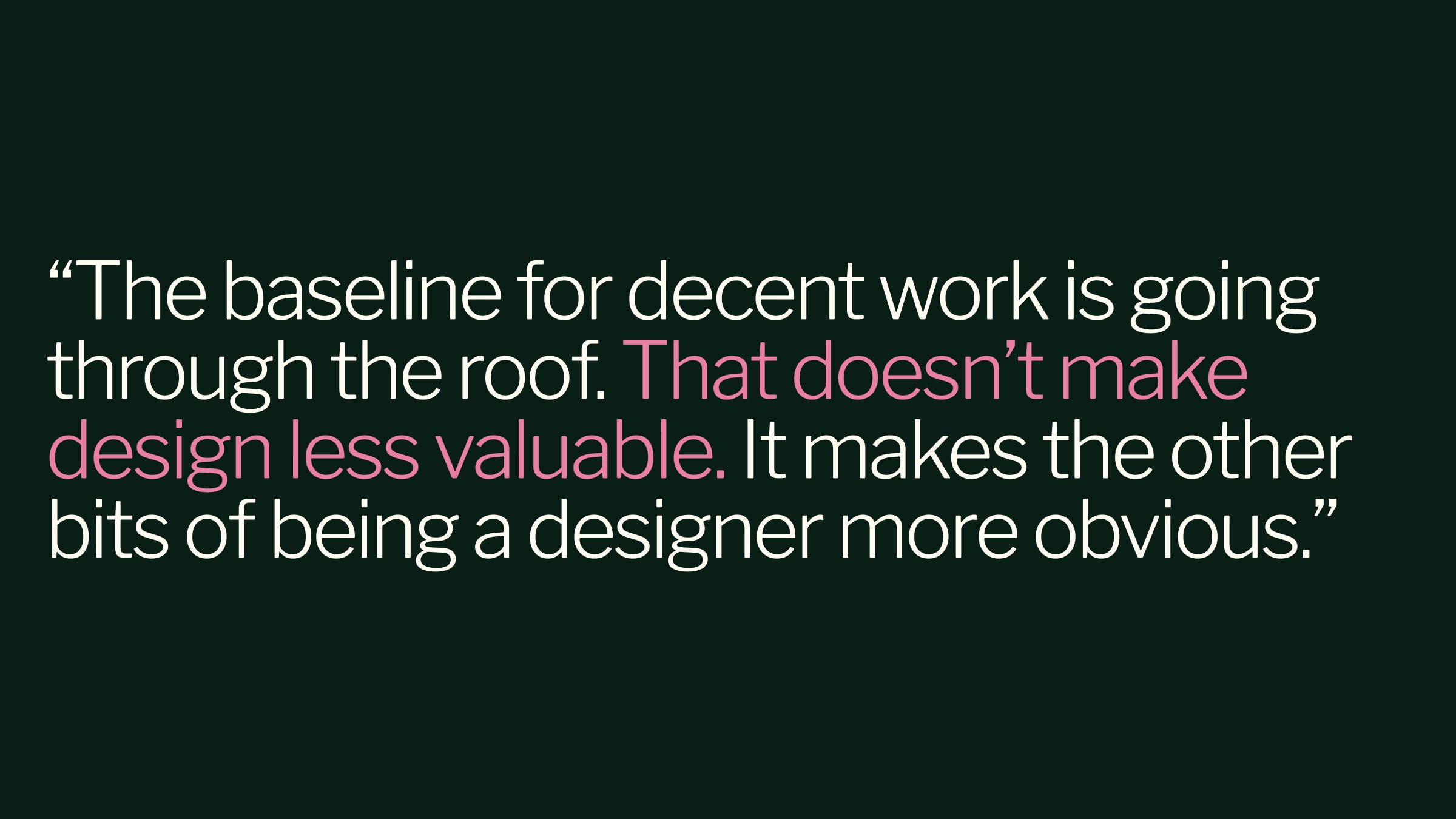
Being honest about that split is what makes the time savings real. If agents handle the navigation, back buttons and form fields, designers can spend their time on what makes a product distinctive: the interaction people remember, or the animation that lifts a pitch. The craft that goes into the brand gets turned into tools, so everyone else can produce work that still looks considered and on-brand. As Tom says, “The baseline for decent work is going through the roof. That doesn’t make design less valuable. It makes the other bits of being a designer more obvious.”
That line between craft and production may not stay where it is. At the Design AI summit in Brighton, we heard predicted the opposite risk: that “craft and taste are only human” may age as badly as “AI will never write production code”. But for now, we’re keeping the fringes with people.
There’s a misconception, and not an entirely unfounded one, that AI makes everything look the same. Left to itself, Tom says, “it gives you the average… It could make the web more samey than ever, only faster.” But built from the right components, and given the right values and design principles, production-ready design can be as distinctive as the brand behind it.
The sameness has a specific cause: most vibe-coding tools build on pre-styled component libraries, so everyone who uses them gets the same buttons, menus, fonts, shadows and greys. “Everything just looks identical,” Andrew says. “It’s got the same shadows. It’s the same grey crap, basically.” Claude Code has its own defaults out of the box, too. You either publish something that looks like everything else on the internet, or you face a messy job of reverse-engineering it into your brand.
We avoid that by starting from the brand. Our skills begin with unstyled building blocks, which carry no visual style of their own. On top of those go the client’s brand rules for colour, type and spacing, then styled components with every state covered, and finally plain-language rules the agents follow. Even then, a system applied exactly as written can look boxy. The best work pairs a tight system with a designer who knows when to break out of it.
This matters more now that everyone can make things. Clients increasingly see near-identical prototypes from several agencies, or as Tom puts it, “everybody can come to the same party with the same dish, all cooked slightly different ways.” However, whilst on the surface they may well have been similar, surfaces are easy to fake. AI, Andrew warns, can make “an app and an argument for an app that seems really convincing… but as soon as you read it three times you realise the words are just nonsense.” What separates good work is the research, judgement and quality underneath, and it’s our experience that gives the strategic depth instead of expecting a prototype to speak for itself.
Crucial, says Andrew, is getting comfortable with sacrificial concepts. Designing with AI means you get to a polished product early, which makes getting attached even easier and moving in one direction an easier trap to fall into. Bad ideas live on too long and, because we can build, we do, which narrows the possibilities of what the product could be.
Design polish can be deceptive, not only for users (which we’ll get into in our AI can, and should, scale human insight article), but for those doing the making. “With a bit of AI,” Tom says, “you can now produce a polished, confident, completely wrong thing in an afternoon.” The risk comes when the level of fidelity available goes beyond the decision-making, missing the steps which would have typically taken place to validate design decisions at each stage.
Building too early has its own cost: teams get attached to the first thing they make and stop comparing ideas. That matters most on greenfield innovation, where nobody yet knows what the answer looks like, and much less on known problems. So we frame problems in words first. We build only when there’s a solution to test and we know what result would change our minds.
Once we do build, cheap making can settle arguments. “When two directions are contested, the loudest person in the room usually wins,” says Tom. “If making things is cheap, you can build both options and let people’s behaviour settle it.” It works for bad ideas too. On one recent validation project, Andrew believes we could have built the real product in the time we spent on prototypes, and found out much sooner whether anyone would pay for it: “You can move bad ideas aside much quicker by making them real, in the same way that you can validate good ideas.”
That only works if people are willing to let go. Andrew has caught himself an hour into a fully working app that was heading the wrong way, reluctant to start again. “Literally delete the code. It has no value anymore,” he says. “So understanding what has value… is a huge mindset shift.” That’s a real change for teams used to treating anything built as an investment to protect.
When building something took weeks, the cost forced a conversation first. A team had to agree it was worth the investment, so ideas were challenged, feedback was given and someone asked whether users actually wanted it. Now a change takes seconds, so that conversation is easy to skip. One person can iterate alone, drift a long way from where the team started, and never stop to ask the question that used to come first.
It happens at an organisational scale too. A product operations lead we spoke to described engineers letting small changes be shipped straight from Slack. Their product manager soon asked: “What happens when 300 changes come in and I have no idea what has changed?… This system is actually worse than just having all of this stuff in my backlog.”
So we’ve put back some of the structure that speed took away. We review iterations together and give feedback on them as a team, because AI’s output tends to narrow the range of ideas and the debate is what widens it again. “We want to debate stuff. We want dissent,” says Tom. “Discussion leads to alignment.” We record decisions as we go: what changed, why, and who signed it off. That way the reasoning survives as well as the result, and we can answer a stakeholder who asks why something moved. Clients increasingly expect it. As Tom puts it, “Clients used to ask ‘can you build it?’ Now they ask ‘can we trust how you built it?’”
Requirements documents are back for the same reason. Writing down what we’re building, for whom and what would prove it right gives every iteration something to be judged against. Before anything gets built, we still ask whether users actually want it. A prototype that answers no question is just a nicer-looking opinion, made faster.
There’s a lot more to say on this and we’ll be updating our playbook as agents evolve. In the meantime, if you want to hear our thoughts (and others’) straight from the horses’ mouths, we’re hosting a second showcase of (silly and serious) design experiments in our studio in February, with some informal talks in-between.