Summer at the Wharf was full of clever people admitting they didn't know things.
Nobody knows what AI will do to design, or to designers. Nobody knows what happens to an organisation when everyone in it suddenly has a superhuman researcher, writer, coder and illustrator living inside their laptop. Nobody knows what the next five minutes look like, much less the next five years.
None of which stops a great many people charging a great deal of money to explain it all anyway. So how do you actually find out?
The traditional answer is to do everything except make something. Innovation theatre, performed for an audience of stakeholders. Commission the report. Run the workshop. Book a day-trip to 'Brainstorm Island' and power-ideate until the Post-its run out. Six months and a lot of excellent coffee later, you have a chunky deck, a sense of momentum, and absolutely nothing anyone can use. It feels like progress, which is almost as good and considerably safer.
The alternative is to make something small, fast and real. And let it teach you what no amount of discussion could.
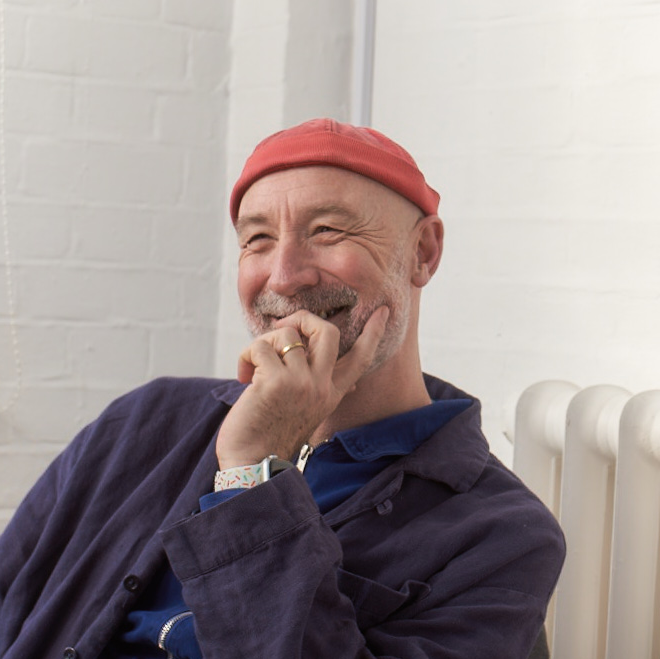
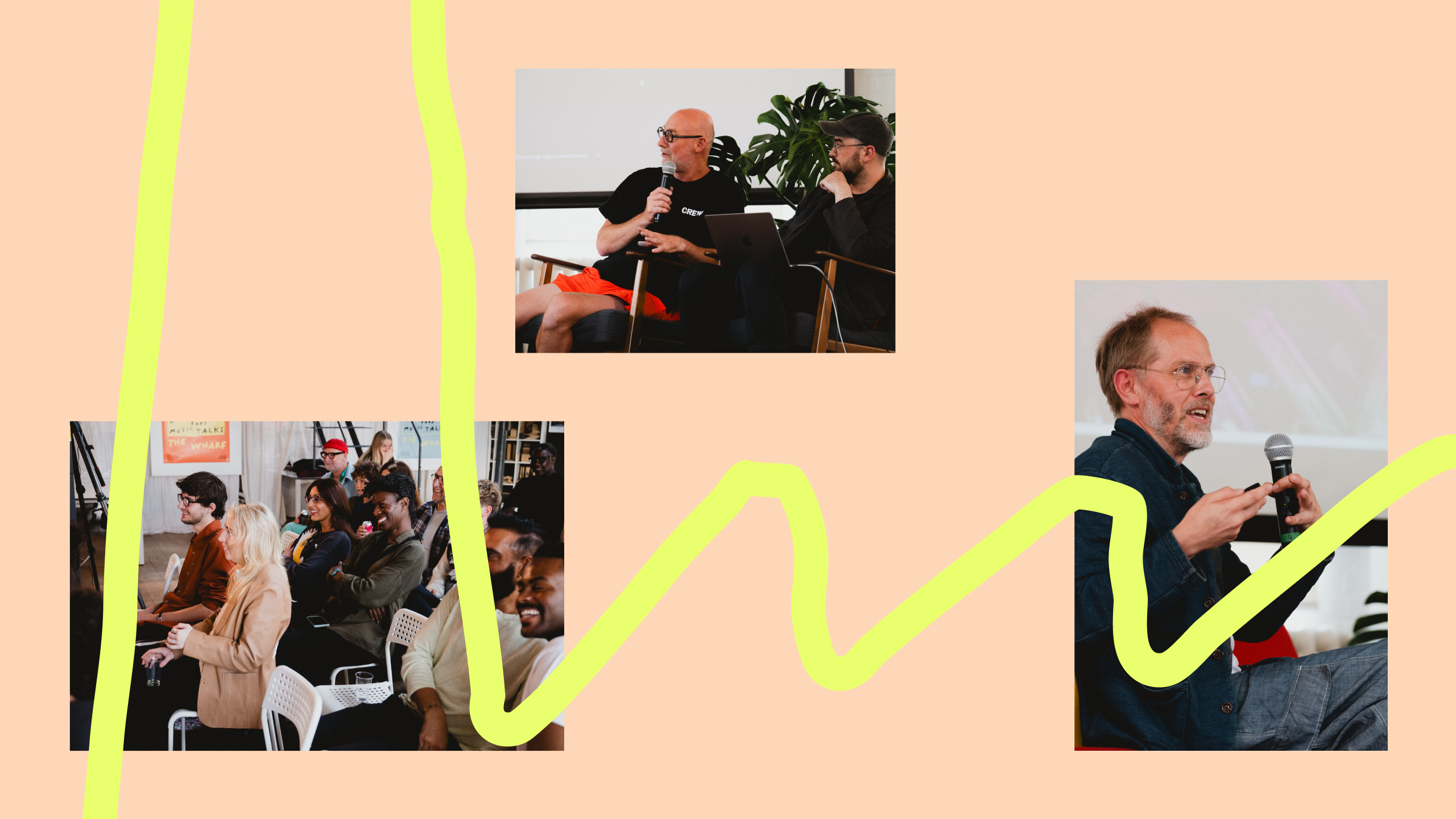
That was the subject of the first day's wind-down session: "Make It," a cosy couch conversation with friend of the Wharf Iain Tait of FOOD, who has spent thirty years cheerfully poking at new technology to see what it's good for. It also turned out to be a fairly neat statement of why Made by Many exists at all. Clue's in the name. When the world changes, the fastest way to understand what's happening is to make something. Not because making matters more than thinking. Because making is a way of thinking. It's often how the thinking gets done.
You can poke life
Iain opened, as all good talks should, with a bit of Steve Jobs. The gist: everything around you that you call life was made up by people no smarter than you. Once you realise that, the whole thing loses its authority. You can poke it. And (genuinely liberating part coming up…) when you poke the world, something pops out the other side. It rarely does this with much dignity.
I'm going to keep using the word "poke" for a bit, because I like it.
Iain started Poke, one of the truly great OG digital agencies, in 2000, with some mates, having been inspired by exactly that Steve Jobs clip. (This bit isn't strictly speaking true. 'This is the only lie I'm going to tell in this whole talk,' Iain said - but it worked better with the Jobs video, and one should never let reality get in the way of good storytelling.)
Whatever. Poke launched just after the dotcom crash, at that weird wobbly moment when everyone was saying this whole internet thing might just not work out. The Poke gang thought there were still a few things worth doing with it. They turned out to be right.
The instinct never went away. We just spent two decades waiting for the tools to catch up.
The most striking thing about this generation of AI is how brutally it collapses the distance between an idea and a working version of it. Iain spent the session showing things he'd actually built. And there were a lot of them.
A wardrobe of AI-generated outfits of himself, one for every year since 1980. A Spotify controller whose eyeballs are the volume knob and whose mouth is an LED display, which started life as a doodle and ended with the model handing him a full parts list. A Northern Soul playlist he fixed by simulating a panel of invented Northern Soul purists and making them argue, on screen, about which tracks to throw out. ("You used invented celebrities to sort a playlist?" asked a baffled developer friend. "Yeah. Why not?")
But there was more… The entire plot and geography of American Pie rebuilt as a Geocities website from a single prompt. A machine for Hinge to help neurodivergent daters, simulating playful versions of the future two people might share (a Raspberry Pi, a customised keyboard, some Peli cases and a line to ChatGPT, tested on thirty real couples). A shop that sells everything he's ever bought on Amazon, fronted by a deepfake of himself rebuilt as a glistening, shirtless man-slab of gym-bro beefcake, here to flog you a USB cable. A tool that photographs your bookshelf and points you to the forgotten classics hiding between the books you already own, and then sends you to your local library to borrow them. Type you rearrange ‘live’ with your hands as you speak. A scrape of everything he's ever made, anywhere online, turned into a little server that now writes his conference bios and renders his career as ASCII art. An identity for the Royal Opera House built from a tool he made and then taught to redesign itself on command. A full sixty-minute Glastonbury show for Cybotron, invented mythology and all, set in a universe that runs on the number twelve instead of ten.
He was, I think, only just warming up. We only had 20 minutes!
The point of the absurd ones is that they aren't only absurd. The Spotify gadget taught him enough electronics, as he went, that he realised he could actually go and build the thing. The playlist trick is a genuinely new way to encode taste. Somewhere inside the silliness is the discovery.
"There are no rules to how you do this stuff now," he said, which was the most useful thing anyone said all festival. These weren't idle speculations about what AI might one day make possible. They were probes into what it allows right now. You no longer have to imagine whether something works. You can find out by tea time.
Which doesn't make thinking less important. Thinking is more important than ever. But when making was expensive, the scarce resource was the ability to make at all. Now that almost anyone can make almost anything, the scarce resource is judgement: knowing what is worth making in the first place.
The brief was always fiction
For a long time, strategy and execution have been treated as two different jobs, done by two different kinds of people. One group thinks; another makes. One writes the PowerPoint; the other ships the thing it describes, eighteen months later, slightly wrong.
We've always sat awkwardly across that line: “the boring wing of the internet”, I've called us in the past. The B2B, the horribly corporate, the serious business problems. Iain, meanwhile, once strapped a GPS collar to a bull and handed out prizes based on where it wandered. He gets the bull; we get the change-management workstream. But the instinct underneath is the same as FOOD's: curiosity first, make something, see what happens.
And that instinct is now the sharpest way to win the work, too. Iain put it plainly: clients are more uncertain than they've ever been. No one can see three months out, let alone five years. So instead of arriving with answers nobody can yet judge, you say: we don't know exactly what you need either, so let's make a few versions and find out. A thing you can hold tells you more than a thing you've been told.
The old way ran backwards. The client, who never quite knew what they wanted, was made to write a brief, which became an RFP, which was (let's be honest) largely fiction. Everyone then spent the first months of the engagement discovering that the fiction was fiction. A wasteful loop, run at exactly the moment the cost of building a rough version and looking at it together has collapsed to almost nothing. The tools are everyone's now, so they aren't the edge. The edge is making faster than you can hold a meeting about it.
None of which is new to us. Smart people are the best in the world at talking about things for far too long; we meet companies that have been debating whether to build something for two years. The most useful thing we can do is end the argument by making a rough version in a fortnight. Something real enough to make an evidence-based decision. The prototype was never the point. The learning was. AI hasn't changed that belief; it's just made it embarrassingly fast.
Making is fact. Everything else is opinion.
Kepler: a question, made tangible
Which brings me to the thing we couldn't resist building for our own event.
This is not a new habit. We have been making things to think with, and timing them to SXSW, for the better part of two decades: Hollergram, which turned an iPad into a glowing sign you could hold aloft in a conference session; Picle, which asked what Instagram would sound like a good year before Vine turned up; a programmable ball called Hackaball that taught children to code by being thrown at walls. None of them was built to become a business. They were built to learn, and to say something about ourselves through making alone.
Kepler is the same instinct, with faster tools.
On paper, it's an AI-powered collective intelligence platform. Which is jargon, and jargon's job is to sound impressive while telling you nothing. In plain English: it's a question we couldn't stop asking, turned into something you could use.
The question ran under the whole festival. AI has become remarkably good at helping individuals think faster, write faster, research faster, decide faster. But almost nothing about human life is lived individually. We make decisions together. We raise barns together. We build organisations together. We solve problems, create culture, and get things gloriously wrong, together. So: can AI help groups think together?
We could have written a paper about it. But Joe built Kepler instead. In about a month, and was still tinkering with it backstage during every session. Across the two days it listened to the event, caught the themes moving through the room, and surfaced the patterns and insights underneath hundreds of separate conversations: a live, shared map of what the room was thinking, drawn while it was still thinking it.
It is deliberately half-baked, and the half we baked was deliberate. I’m sure you can imagine the internal brief. It was filled with clever things: ‘a chatbot you could quiz the whole archive with’, ‘a map of every idea and how it linked to every other’, ‘a what-if scenario engine’ (what?!). We built almost none of that stuff. We built the plain spine: ‘catch what the room is saying, surface what it means’. And the places it fell short taught us more than the places that worked perfectly, which is exactly what an experiment is for. Much of what we make, we make to prove something: build enough of it to prove it, as we like to say. Kepler was the other kind of making. We built enough of it to find out where it breaks.
Good AI, bad AI
Iain ended on a distinction worth keeping.
There is good AI and bad AI, he said. Bad AI is the one the discourse is obsessed with: efficiency, cost-cutting, doing the same things slightly cheaper, quietly replacing people. Good AI creates value that didn't exist before, and lets people make things they could never have made: harder, stranger, better things, not cheaper ones. His worry was this: if curious, generous, creative people sit this one out because the technology makes them queasy, the only people left shaping it will be the ones you'd least want shaping anything.
Or, as he put it himself: "a bunch of assholes shaping the technology into something terrible."
And then, having sworn at the future, he said the thing that stuck:
"I've been a professional creator for thirty years, and I've never felt more capable of expressing myself than I do today."
Not threatened. Not replaced. More capable.
The public conversation about AI is fixated on replacement. A zero-sum game: what the machine will do instead of us. The more interesting story, and the one running quietly through the weekend, is amplification. Not what AI does instead of people. What people can do with it.
When the world gets more uncertain, making gets more valuable. Not because making matters more than thinking but because, when nobody has the answers yet, making is the only kind of thinking that has to survive contact with reality.
So we'll carry on building things. Small things, mostly. Some beautiful, some ridiculous, most of them wrong in instructive ways. It remains the best method we know for finding out what comes next.
Stop talking about it. Start making it.