As part of Made by Many’s Gen Z Futures project, our Gen Z collaborators Aarti and Anastasia are unpacking how their generation is redefining industries, from wellness to fun and shopping. Through interviews with peers, research and first-hand insights, they’re exploring what’s changing, what’s next, and what businesses can do to get ahead.
I, Anastasia, have been exploring why my peers and I behave the way we do, how our idea of 'fun' keeps changing, and what this means for the future of your business. Through my own research, data analysis, voxpops, and interviews, I’ve gathered insights on how Gen Z is having fun indoors, outdoors, and abroad. These insights are shared across three blog posts, so you can hear it straight from the source. This is the last of the three.
Forget the doors, it's about borders
When it comes to Gen Z’s tendency to seek ‘new experiences’ travel comes out on top. Cheap short-haul flights and the rise of budget-friendly alternatives to traditional hotels have made travel more accessible. At the same time, Gen Z entering the workforce in the post-COVID era has normalised flexible hours and remote work, fuelling a a desire toward work-from-anywhere lifestyles. 28 per cent of Brits have hybrid working (Office for National Statistics) and 16 per cent of American Gen Z are already operating as digital nomads (Howdy), centring their lifestyles around their travel dreams. 25 per cent of more traditional Gen Z holiday makers prefer to travel alone, owing to increased safety and connectivity around the globe (Travheir).
As a generation that is purposeful with how we spend our money, the fact that we are spending up to 49 per cent more on travel than older generations with the same income (Smiler) sums up its importance to us. In 2023, over 50 per cent of American Gen Z took three or more leisure trips (Morning Consult) and this number will only continue to rise as we gain larger disposable incomes.
We deem travel as an essential part of our lifestyles, so it’s inevitable that we’ll spend a good proportion of our income on it, but it’s not just frivolous spending or about hitting ‘30 before 30’; we seek value for money and authentic experiences. The appeal of ‘hidden gems’ and ‘secret locations’ on TikTok and Instagram work tremendously well as a hook for discovery and the start of yet another holiday shopping hunt.
We seek value for money and authentic experiences.
Once the search begins, we can be extremely resourceful, after all we are digitally native and we know the value of online comparison sites; 62 per cent of us use a minimum of three OTAs (online travel agencies) as search tools to compare prices before booking our flights. The fun is in the hunt for ‘bang for buck’ flights with generous baggage and the perfect flight times. We are also 30 per cent more likely than the average flyer to book our flights directly through an airline’s website, keen to cut out third parties (Mighty Travels). The airline that will give us the best package at the price we want will trump brand loyalty every time. Still, of any generation, we are part of the least amount of loyalty programmes (Fast Company).
WizzAir’s ‘All You Can Fly’ subscription has tried to tap into a loyalty programme compatible with Gen Z’s thrifty mindset and certainly caused a positive stir among my generation. It sold out within 24 hours, demonstrating the high level of demand, but, as a first of its kind deal, whether it will generate profit for them is still to be seen.
The WizzAir subscription does shine a light on one thing in particular: Gen Z are not as caught up with sustainability as you might think.
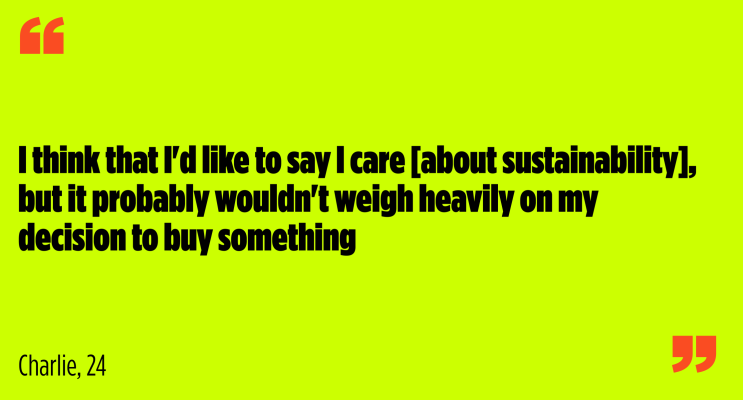
While a poll by TravelAge West determined that 50 per cent of Gen Z say they lean towards booking with companies that have ‘strong green credentials’, their penchant for cheap, frequent flying suggests that, in practice, better value matters more than better for the planet.
Perhaps when we have the money to travel in a more sustainable way, or at least pay to offset our carbon emissions, we will. But for now, the cheapest flight is a far larger consideration than the most sustainable one, and the option to not fly for the sake of the environment seems to hardly cross any of our minds.
Value for money does not always mean cheap.
While currently with our tight budgets, cheaper airlines generally appeal to us, my friends with Amex’s are using their points and British Airway companion vouchers for all they’re worth. And as our budgets increase we will start to look at what luxury airlines can offer us that cheap ones can’t. The way to stand out to Gen Z as a more expensive airline is through value and personalisation. I wouldn’t mind paying more money if I thought it was really worth it and tailored to my interests e.g., a lounge I could make a work call from, bespoke food service (bonus points if its instagrammable), flexible booking, or even Swiss Air’s skis fly free policy. Expensive airlines should make it clear to us thrifty GenZers that paying more is really worth it and aligns with our interests.
We want to stay somewhere unique and authentic, not at an all inclusive. Drinking less has shifted the focus of travel away from the cheap bar and towards ‘authentic’ experiences with a 2023 CNBC study revealing that only 21 per cent of 18-25 year olds went travelling in search of nightlife while 68 per cent went to experience a new culture.
While hostel experiences are also on the rise, Airbnbs in particular have thrived among Gen Z with 20-30 year olds making up a third of their users in 2024 (IGMS). Airbnb’s service answers our want for personalised, unique, authentic and immersive experiences. Gen Z don’t want a hotel room that looks the same as any other hotel room, or worse, an all inclusive. We want to stay in a place that feels authentic and allows us maximum immersion in the culture. The often lower cost of Airbnbs compared to hotels doesn’t hurt either.
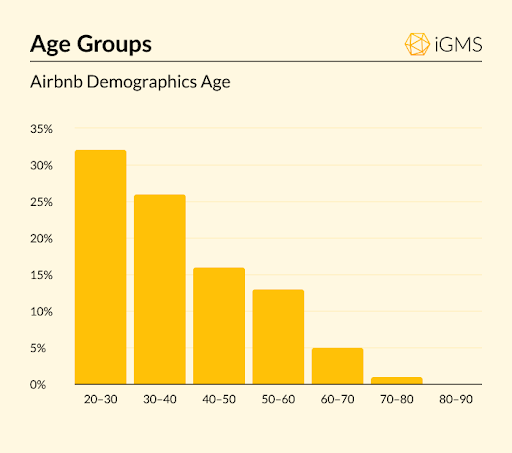
A graph demonstrating the dominance of Gen Z using Airbnbs, USA
As work becomes more flexible, nomadic living is seeing a huge increase with 23 per cent of Airbnbs in America being booked out for 28 days or longer (Forbes). Many of us are keen to experiment with the Nomadic lifestyle so ensuring the places we stay can cater to this through good working spaces and wifi is essential.
Airbnb utilises Instagram to capture the attention of Gen Z by posting their unique stays. Most of this Instagram content are not places that Gen Z can afford, or find availability for the next year, but it will get them sharing Airbnb’s content.
We will trade in authenticity and cheapness for something unique.
Gen Z takes the same approach to splashing out on hotels as luxury airlines. We will book them if we think it’s worth it. In an ideal world, a variety of price points so that Gen Z can tailor their room to their budget could be a perfect solution, it would also make the hotels unique enough that they warrant a social media post, boosting their appeal to digital nomads or solo travellers.
Generator Hotel is an excellent example with its focus on unique buildings and rooms, Moxy Hotels by Marriott cater to solo travellers by advertising communal spaces, and Freehand Hotels have a penchant for instagrammable features. All of the aforementioned hotels do not charge ridiculous sums either, maintaining Gen Z’s need for value for money.
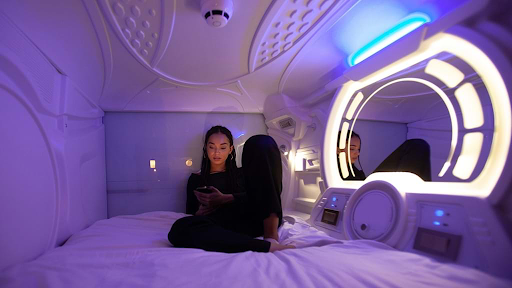


The key to reaching the Gen Z travel market is through offering a range of ‘unique’ and ‘authentic’ accommodations at a range of prices, and lengths of stay just like Airbnb, or Booking.com.
Travel and content go together!
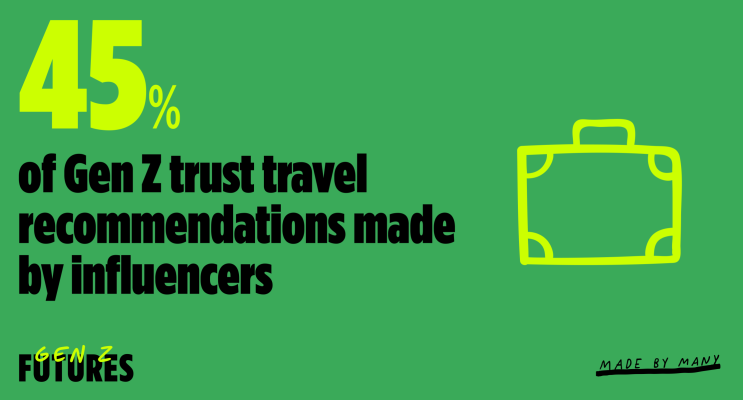
TikTok as a means to find ‘unique and secret’ places is perfectly positioned to be a key feature of the travel world. 88 per cent of Gen Z with TikTok are following at least one travel influencer (TravelAgeWest) and 45 per cent of Gen Z trust travel recommendations made by influencers (Travheir).
We’re driven by desire; it’s not just about the ticket, but the narrative sold to us. It’s a worthwhile strategy for travel businesses to think like media companies if they want to engage Gen Z. This means not just transporting them but also inspiring them with original content and influencer collaborations to amplify the uniqueness of a place or activity.
Gen Z value ‘hidden gem’ locations more than every other generation with 72 per cent reporting having visited somewhere that their peers had not yet discovered (Mighty Travels). Not limited to seeking lesser known destinations, 68 per cent of Gen Z have taken part in at least one ‘underground’ or ‘secret’ event on their travels (Expedia). Visiting these spots is not limited to just visiting them. A large pull of some places is the opportunity to Instagram that you have been to them. What used to be pictures of the Leaning Tower of Pisa have become secret beaches in Cornwall and a bar entrance through a washing machine in Paris.
The quick turnover of ‘secret’ activities
The downside of using one of the most popular social media sites to discover ‘secret’ places is that they don’t stay secret for very long. As hordes of people come flocking to the newest ‘secret, unique’ spot, prices soar and crowds ruin the perfect Instagram shot. If you are wanting to advertise a unique spot, you’d better have five more up your sleeve as one by one they get discovered and, in time, ruined.
Package holidays of the future
Despite our preference for tailored and authentic experiences, there is still room for package holidays redefined to suit Gen Z. Journee is a good example of a personalised twist on the traditional package holiday. You fill in a 10 minute questionnaire and Journee books everything for you. At the airport you discover where you’re going, what you’re doing and where you’re staying. This speaks to Gen Z’s appetite for novelty and adventure, while saving them the hassle of having to plan it themselves.
One travel industry area that has been particularly slow to adjust to Gen Z’s values are cruise companies. Traditionally cruises follow a standard route (bypassing the ‘hidden gems’), have poor wifi connectivity, and are generally perceived by Gen Z as a reserve of the older generations.
One company that is doing it right is The Royal Caribbean Group.
They have 1.3 million followers on TikTok and regularly partake in trends likely to get them onto Gen Z feeds:
A quick scroll through their TikTok reveals the plethora of activities they offer on board (novelty, tick!) or a glance at their website reveals the plethora of cruise lengths and routes they have (tailoring to interest, tick!). Royal Caribbean also appeal to value-seeking Gen Z by positioning themselves as one of the cheapest ways to see the world and it has paid off with half of their passengers today being Gen Z or millennials. And not only are they getting Gen Z aboard they are making them want to go again. The Cruise Lines International Association found that 74% of the Gen Z from their cruises plan to cruise again.

The way we travel is reshaping your industry. We value authentic over commercialised, tailored over generic, value-for-money over eco-friendly, for now at least. When we leave the indoor and outdoor fun of our home countries behind, we want to be met by quantifiable value for money from airlines, unique offerings from hotels, and ‘secret spots’ for our itineraries. We are set to travel more and more, both short haul for weekends away and long haul for more ‘hidden gems’ and nomadic work offerings. Reach us through social media and provide us with a range of authentic or unique experiences at competitive prices and you will lead the future of travel.
Remember, for us travel isn’t a luxury, it is essential. Respond to our needs and you will become essential as well.