Innovation Has a Permission Problem
Reflections from Summer at the Wharf 2026
There's an interesting paradox at the heart of innovation. Somehow, the discipline centred around bringing new ideas to life has spent the last few decades behaving as if imagination were somehow scarce. We've built job titles to protect it, workshops that drive it, and rooms to facilitate it. We are constantly asking people to think bigger, challenge assumptions and produce more possibilities. But do we really mean it?
Most organisations do not have a deficit of ideas. They have quite the opposite, in fact. They have an abundance of research-never-acted-on, pilots-never-launched, decks-never-executed, and conversations-with-pins-in. Ask any smart team in a business what could be improved and they won't struggle to tell you. There's just the small problem of "yes".
Innovation has been mis-describing itself for an awfully long time. It is not primarily a creative process that occasionally gets tangled in organisational politics. It is an organisational process, where creativity is only the opening move. The real job is turning uncertainty - be it a suspicion, a gamble, a hedge, a prediction - into something the institution is willing to permit.
I introduce to you: the permission problem.
The "yes" is the work
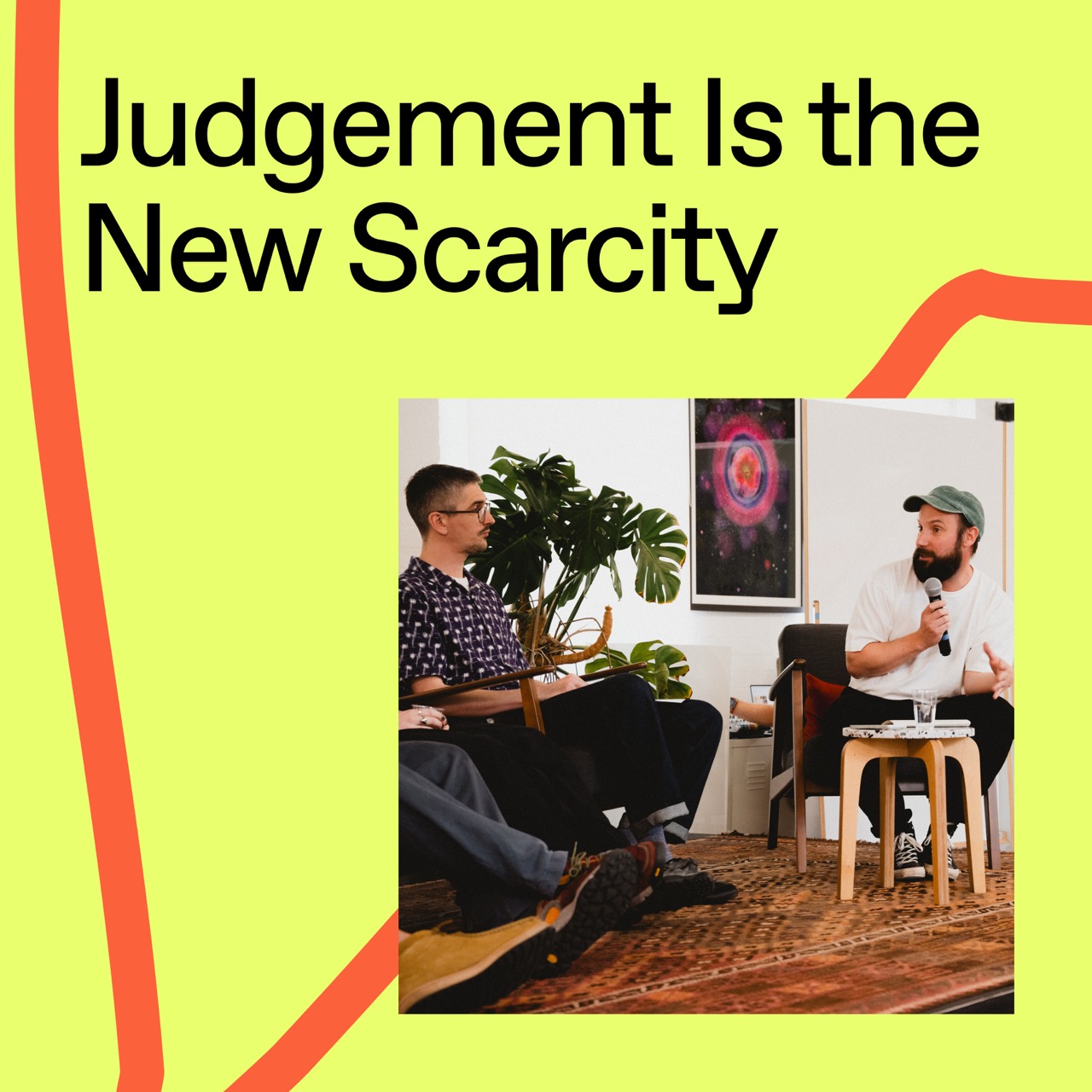
Ivan Heredia, one of four voices on the Future of Innovation panel at Summer at the Wharf, has spent a career moving change through institutions, from Disney to a 120-year-old youth development organisation, and he sees the problem as something structural: a matrix of stakeholders, each of whom has to decide individually to believe in a thing before it is allowed to exist. “Not a technology problem,” in his words, “but a legitimacy opportunity - getting people inspired and believing as the very first step.”
What is permission? It sounds deceptively simple, a simple decision made by a sufficiently senior higher authority. In practice, permission lives scattered across an organisation as a living, breathing, reactive system of behaviour.
There is permission to spend money. Permission to speak to customers. Permission to use real data. Permission to change a process. Permission to create risk for an established team. Permission to stop doing the old thing. Permission to start doing the old thing again. Permission to be wrong in public. Permission to own the result if it works.
Each belongs to someone different, and each person is behaving rationally. The security team is there to prevent reckless access. The finance team is there to stop money leaking into vague promises. Operations is there to keep the current machine running. Leadership is there to guide the teams they commit themselves to.
Large organisations are not badly designed because they resist uncoordinated change. In fact, resisting uncoordinated change is a large part of what they are designed to do.
Innovation asks that system to make an exception.
The Prototype Is Political
The obvious course of action is to produce a stronger business case. But the business case is usually treated as though there were one audience, with one definition of value. There isn't.
A customer team may need evidence that people want the thing. Finance may need to see a credible route to revenue or savings. Operations may need to know it won't create a second invisible job for hundreds of people. Risk may need to know every plausible point of failure. A senior stakeholder may need to understand how it advances the organisational strategy. These are not objections to be overcome, but simply different ways permission manifests itself, and each time a different proof point is required.
Mordecai, formerly of Gartner and Hyundai and now running Day After, put it directly: “innovation is a translation business.” The product working is never the full story. A proof point that convinces one stakeholder does nothing for the next - some wins look like a team learning a new capability; others look like trophies from Cannes Lions. The job is knowing which proof settles which room.
How can innovation account for these challenges when its value is not obvious, numerical or immediate? A story often is not enough. Nor is a signal, or an instinct. Wireframes compel, but they don't answer questions. Technical feasibility should be a given in itself. Enthusiastic senior stakeholders don't guarantee strong, visible ownership. So what can be done?
Making absolutely changes the equation. We'd know.
An abstract idea is easy to misunderstand and all too easy to dismiss. A prototype gives everyone the same thing to react to. It turns an argument about imagined futures into a conversation about something that exists. It anchors the exact conversations that slip into the realm of suspicions, edge cases and "what-if" scenarios. The best versions of these are small enough to be allowed, real enough to learn from, and specific enough to settle a decision. The best part? They're not asking to be believed in as the future, or even the market launch. They're just there to earn the right to take the next step.
Ivan's answer to the bottleneck was smaller than the problem seems to warrant: “socialising proof points and micro-experiments to get that trust”. Shown to the right people often enough, the reassurance and belief you earn outpaces scepticism. In large-scale operations, these incredibly complex matrices of permission, it’s extremely rare to earn belief all at once. But you can in instalments.
AI prototyping makes the permission gap impossible to hide
Making used to move at the speed of deciding. A convincing prototype took months, which was roughly how long it took to gather the meetings, the budget and the informal nods along the way that kept ideas afloat. Slow building gave slow permission somewhere to hide.
That model, with today's tech, is a recipe for disaster. The speed of output is accelerating exponentially, and the cost of doing so trending to near-zero. A small team can, in theory, launch a fully working prototype from scratch in a day, well before booking the meeting with their senior leadership to decide whether it should exist.
The structures that govern experimentation - what to try, how to fund it, when to kill it, when to ship it - were designed for a world where making was slow and expensive. That world is over, and those structures haven't yet caught up.
Geraint Jones described what that neglect looks like in practice. AI adoption inside most large organisations didn't begin with a customer problem. It began with a share price problem, where shareholders leaned on chief executives to do something visible with AI. The tools arrived without the purpose, the governance, the mandates, or the frameworks that should have come with them.
Arse about face, was how he put it. Eighteen months on, companies are still walking their leaders back through decisions that were never actually taken, trying to retrofit the business case after the deployment.
What AI has exposed, Geraint argued, is a gap that was always there. Knowledge is now at everyone's fingertips. The understanding layer - the experience, the taste, the clarity of whether something is the right thing to do - is not equally distributed, and every output these tools produce makes that more obvious.
Build the ladder
None of the panel's advice was really about ideas. It was about trust, in every form trust takes inside a large organisation: trust that a small experiment will scale, trust that a budget line means what it says, trust that employees using these tools daily don't need to hide it from the people who should be leading the adoption, trust that this year's innovation function won't be quietly dismantled the way the last one was.
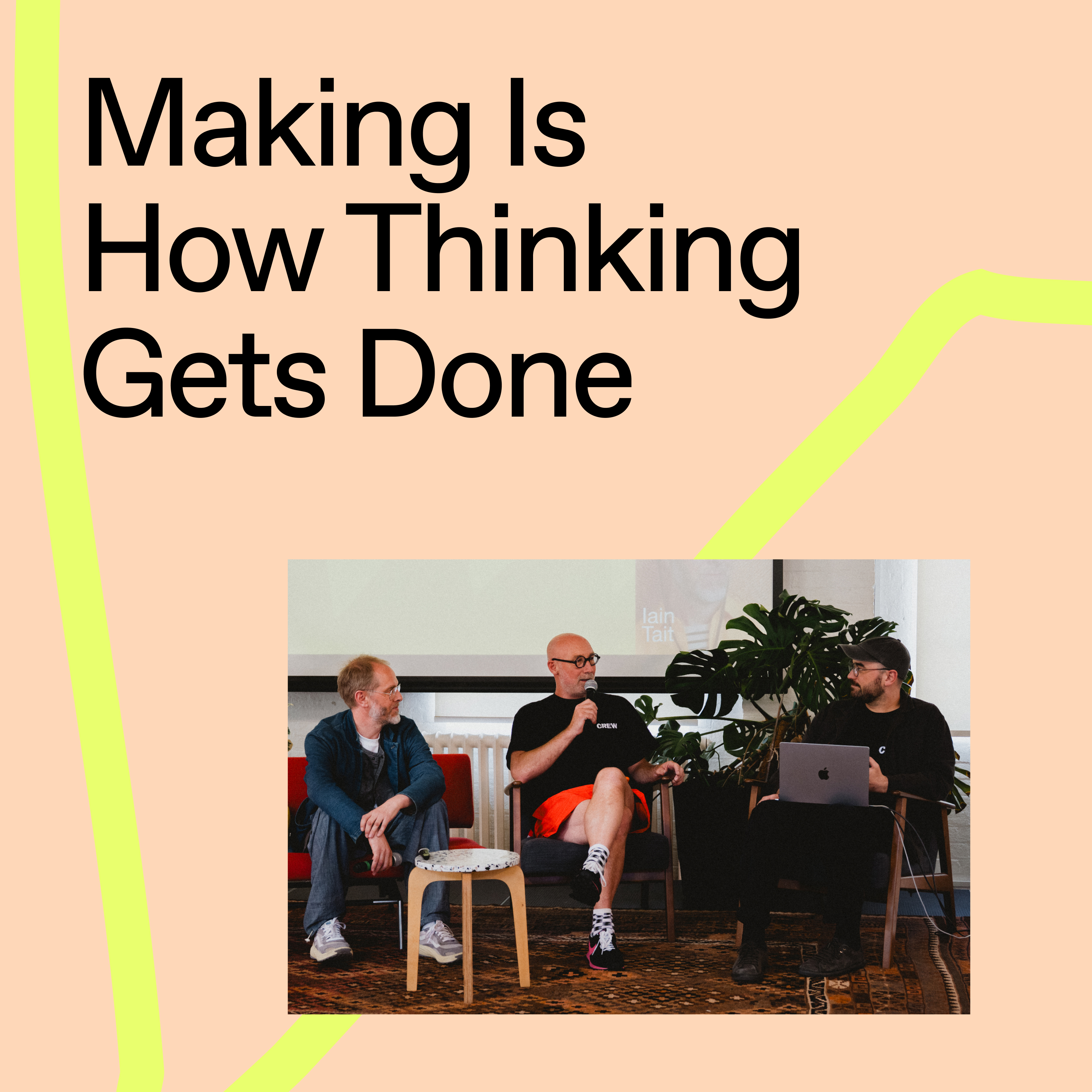
At Made by Many, we argue that making is how thinking gets done. It is also how belief gets built - but only when the route from evidence to action is designed alongside it. It doesn't take a radical organisation to start experiments. But it takes one to absorb the benefits of successful ones. The gap between a promising prototype and a funded service is where belief, sadly, goes to die, and that gap is made of unanswered questions: who owns this, who funds the next step, what happens when it works.
Each of those questions is a rung. Bounded risk, a decision-maker, evidence that settles one specific doubt. Miss a rung and the experiment invents its own route to scale long after the excitement has gone. That is where most of them end - the innovation graveyard.
Cheap tools were supposed to flatten all of that. They haven't. If anything, they've made the permission problem more visible - the only thing standing between an idea and reality is a room full of people deciding whether to believe in it.
But the prototype does change the conversation. When done well, it gives that room something to react to instead of something to imagine. It settles doubts that no deck, no strategy document, no amount of talking ever quite could. The tools have made that faster, cheaper and more convincing than it has ever been. That part of the job is solved.
The rest––the structures, the governance, the ladders that turn a successful experiment into a living product - hasn't moved. Ideas were never the bottleneck; permission was, and it still is. The tools themselves said “yes” months ago.