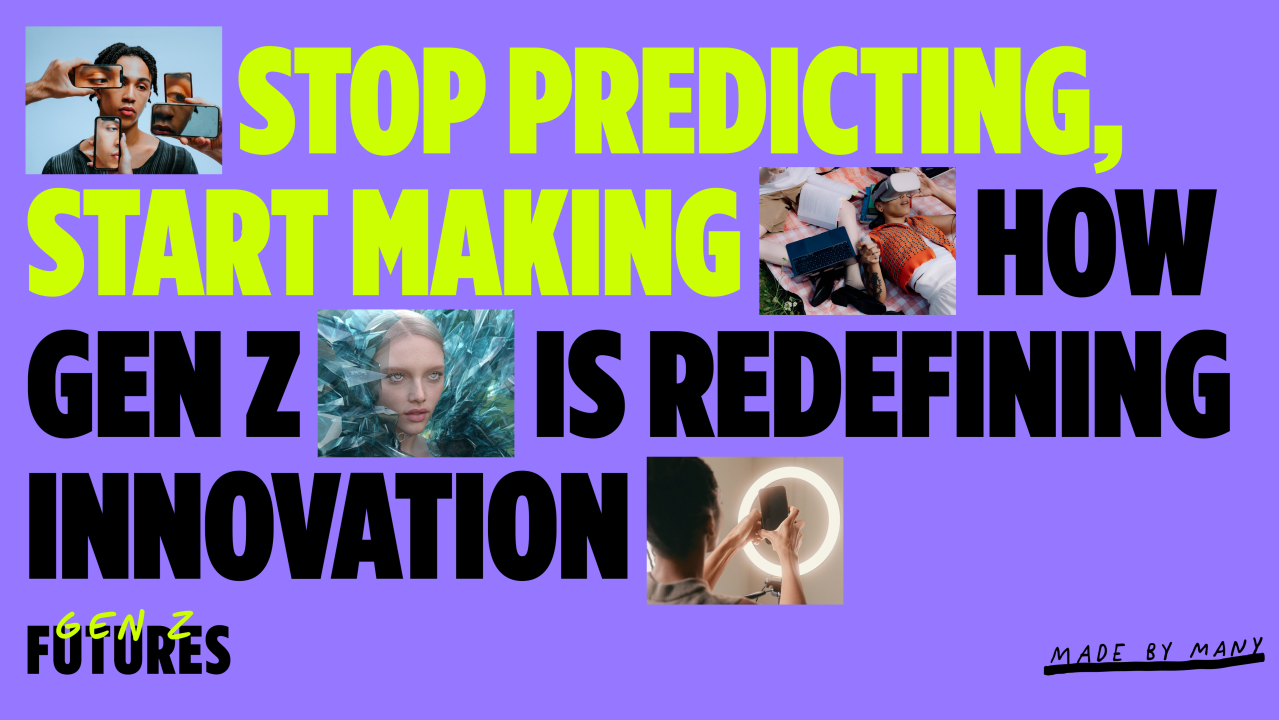
Don’t worry. This won’t be another breathless take on ‘exponential whatever’ or how hard it is to keep up with the speed of change in these unprecedented times.
Yes, the world is evolving. Fast. New customer behaviours, new expectations, new ways of creating value. But for businesses, this isn’t something to fear, it’s something to build with.
The smartest companies aren’t sitting in meeting rooms trying to predict the future from a distance. They’re in it. Building and testing with the people already shaping it.
Gen Z Have Entered the Chat
Four generations of customers exist and consume at once, each with different expectations. But Gen Z is the one pulling the future forward.
They aren’t just another emerging consumer group. They’re the first generation raised in a fully digital world. They don’t just consume; they create, critique, and reinvent everything they engage with.
The brands leading the way aren’t just watching Gen Z. They are giving them a seat at the table. Learning, making and adapting what’s coming next alongside the generation already shaping the future.
Why? Gen Z behaviours set the standard for everyone else. What they adopt today doesn’t just stay within their generation. It defines the next era of consumer expectations across industries.
This isn’t a challenge to keep up with, instead, it’s an opportunity to get ahead.
Bridging The Gap Between Strategy and Execution
The best ideas don’t sit in decks. They shape industries.
The most successful companies haven’t just kept up with change, they’ve shaped it. But as markets move faster and less predictably than ever, staying ahead now requires a different approach. Instead of treating innovation as something to be mapped over a five-year plan, businesses thriving today are delivering new capabilities and growth in real time.
Technology has collapsed the space between idea and execution. AI, new creative tools, and digital platforms make it easier than ever to bring new ideas to market fast. Entirely new categories can emerge overnight. Meanwhile, many businesses are still stuck in traditional innovation cycles, spending months analysing the future instead of actively shaping it.
Why Making Complements Strategy
Strategy development is essential. But strategy alone doesn’t create change, and too often, the gap between strategy and execution can feel big.
Big ideas get locked into decks, passed between teams, and discussed in meetings instead of being put to the test in the real world. Making stuff early can close that gap.
The companies leading today are strengthening their strategy by bringing ideas to life earlier in the process. They test concepts with real users, prototype quickly, and refine innovation in the real world. They de-risk bold decisions, speed up learning, and prevent teams from investing in ideas that look great on paper but fail in practice.
Instead of deferring innovation to a distant pipeline, companies that experiment and iterate now are learning faster, adapting earlier, and making smarter bets before their competitors even realise the opportunity exists.
You Can’t Design the Future by Looking in the Rearview Mirror
Traditional research tells you what people already know. While it’s useful for capturing and interrogating existing behaviours, it’s far less effective at predicting what’s next.
People don’t always know what they want next. But they do know how they react to something new. When you build prototypes and test them in the real world, you create the conditions for unexpected insights, uncovering behaviours and opportunities that research alone would never reveal.
Innovation isn’t a puzzle to be solved in a boardroom. It’s a process of building evidence, learning through action, and adapting as you go.
What Making Can Teach You That Research Can’t
Making doesn’t just tell you what customers want. It shows you what actually works.
It reveals blind spots that focus groups will never uncover. And it cuts through the lazy stereotypes that lead companies to misunderstand their users altogether.
It’s easy to fall into the trap of relying on broad-stroke personas about your customers. But these oversimplifications can create misunderstandings, leading to poor decisions and missed opportunities.
Making challenges these assumptions. It doesn’t rely on what people say they do, it observes what they actually do. Rather than second-guessing, it puts ideas in front of real people, in real contexts, generating sharper, more actionable, and often surprising insights.
Why Making With Gen Z Matters
The gap between assumption and reality is even wider when designing for younger generations.
Most executives are far removed from how Gen Z actually uses technology, discovers brands, and makes decisions. They have an idea of what Gen Z should want, but that doesn’t always align with how Gen Z actually behaves.
Too often, businesses rely on broad personas and outdated stereotypes, thinking of Gen Z as “digital natives” with short attention spans, rather than complex consumers with distinct behaviours, values, and contradictions. These oversimplifications lead to missed opportunities, misguided product decisions, and messaging that doesn’t resonate.
The only way to truly understand what Gen Z wants is to build with them, not just for them.
Whether by co-innovating with Gen Z instead of just studying them from afar, or by co-designing with them rather than designing for them, companies gain sharper, more actionable insights than traditional research ever could.
Instead of second-guessing how younger consumers will react, you see it firsthand. Instead of debating what might work, you test, refine, and adapt with the people who will actually use it.
By embedding Gen Z into the innovation process, businesses don’t just gather insights, they bridge the gap between assumption and reality, ensuring that the products, services, and experiences they create actually connect.
Why Making Outpaces Research: A Real-Life Example
The companies shaping the future aren’t the ones that spend the most time analysing it. They’re the ones that make, test, and learn the fastest.
Traditional research assumes you can plan your way into the future before you’ve even tested anything in it. But no amount of insights will bridge the gap between theory and execution.
If you want to know what will resonate, you have to build it, put it in the hands of real people, and see what happens.
That’s exactly what a leading technology company did when they worked with Made by Many.
When they needed to understand why younger audiences were bypassing Search for TikTok and social discovery, they could have just commissioned another research report. Instead, they brought Gen Z into the process.
We worked directly with them, built prototypes, and tested real interactions not just hypotheses.
The result? New product features that increased engagement by 40%.
Making doesn’t just uncover the right ideas. It shows whether a company can actually act on them. Because the biggest challenge in innovation isn’t spotting opportunities. It’s having the speed, culture, and structure to do something about them.
The Future Won’t Be Designed in Boardrooms
The companies shaping the next decade aren’t the ones drowning in reports. They’re the ones building, testing, and iterating in the real world.
Market research will give you a map, but it won’t build the road. Five-year strategies will help you talk about change, but they won’t create it.
The only way to get ahead is to stop overanalysing the future and start making it.
And Gen Z? They’re not a focus group. They’re co-creators.
The smartest businesses are already working alongside the most design-literate generation in history to uncover what’s next and, more importantly, build it together.
So What’s Next?
Over the next few weeks, we’ll be exploring how Gen Z is already reshaping industries, from fun and wellness to shopping.
Together with our Gen Z collaborators, Aarti and Anastasia, we’ll dive into how their behaviours are transforming categories and, more importantly, how businesses can act on these shifts.
Follow along as we reimagine the future of industries with the best innovation team out there: Gen Z.