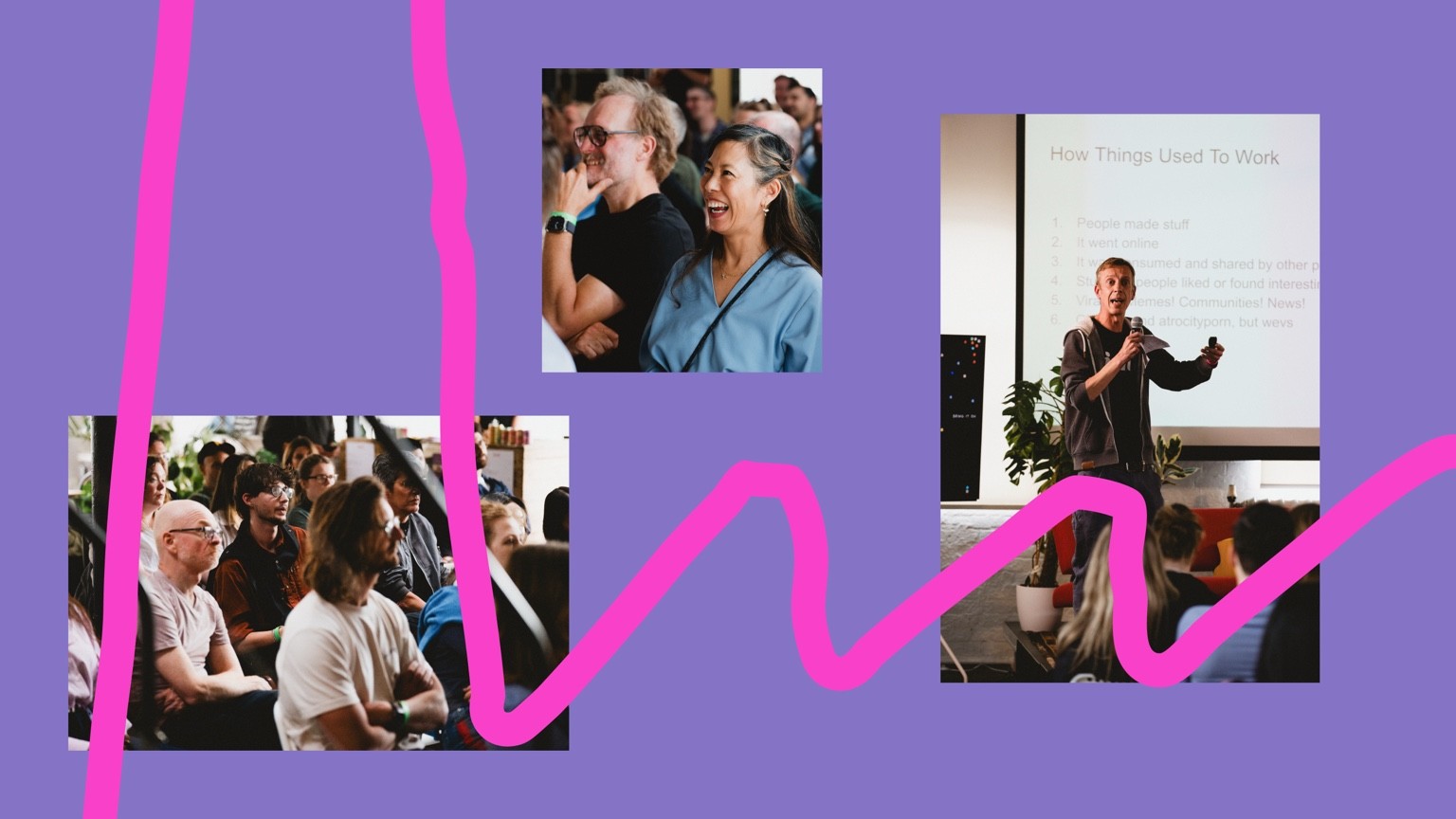
At Summer at the Wharf this year, Matt Muir, author of the legendary Web Curios newsletter, gave a talk called Everything Online Is Weird Now.
The audience laughed a lot. They also looked slightly traumatised. Both reactions were correct.
Matt was trying to name something all of us feel but struggle to articulate. The growing sense that the internet has become a strange place. Not bad, exactly. Or broken. Just weird.
You can't spend five minutes online without meeting something that feels slightly off. A political argument conducted entirely in screenshots. A video engineered to provoke. An AI-generated image of Shrimp Jesus with forty thousand likes, every commenter an account created on Tuesday. A soup recipe prefaced by 1,400 words about the author's grandmother. A feed that knows, with faint menace, exactly what will keep you watching.
The weirdness isn't confined to one platform. It permeates the whole experience.
It's tempting to blame all this on AI. But the weirdness started long before ChatGPT. AI just poured petrol on it.
And it now has a number. In June 2026, the same month we gathered at the Wharf, Cloudflare reported that, for the first time, bots had overtaken people. Automated requests now make up around 57% of the traffic to the web pages it serves. Its chief executive admitted the crossover arrived faster than he'd predicted. Here we are. The web is now mostly machines performing for other machines. Bots writing posts for bots to summarise for bots to rank. An entire economy of synthetic enthusiasm. Us locked outside, faces pressed to the glass like Dickensian urchins.
One possible explanation for all this is that all the machines have suddenly become weird. Another is that we’ve spent twenty years building systems that reward weird behaviour, and now we’re surprised by the result.
From a human web to a machine web
The early web was built by people, for people. Messy, amateur, inefficient, bonkers, and often wonderful.
People made websites because they cared about something. They shared links because they were interesting. Communities formed around obsessions. Discovery was imperfect, but it felt much, much more human.
Today's internet feels like a different animal. The systems deciding what we see aren't built for human connection at all. They're built to engage you. Retain you. Monetise you. Predict your behaviours. Growth über alles.
Somewhere along the way, the internet stopped feeling like a place and started feeling like an industry.
The feed is not really a window onto the world anymore. It’s a factory floor. Our attention is the raw material. Our behaviour is the product.
Shoshana Zuboff called it surveillance capitalism: human experience harvested, refined into predictions, and sold to whoever wants to influence what we do next.
The next stage is harder to miss. Platforms that once felt useful turn extractive. Search gets yucky. Feeds get noisier. Advertising creeps into every available surface. Cory Doctorow nailed it with “enshittification” - a word so powerful and resonant that it defeated “rawdogging” to snatch ‘Macquarie's Word of the Year’ in 2024.
“We’re all living through the Enshittocene - the Great Enshittening - a time in which the services that matter to us, that we rely on, are turning into giant piles of shit”. Cory Doctorow, Enshittification
Platforms begin by serving users, then advertisers, and eventually themselves.
The end state is a "global digital ghost mall." A landscape increasingly crowded with scams, junk and synthetic content.
The internet hasn't disappeared, but it increasingly feels as though we are living inside systems built for machines. And that does feel weird. It should do. It is weird.
The death of shared reality
Mass culture may be quietly disappearing, but not because we are less connected. It’s because we are connected differently.
Historically, that may be less strange than it feels.
For most of human history, culture was local: family, community, region, tribe. The era when whole nations watched the same programmes, read the same papers and shared the same references may turn out to have been a brief anomaly, enabled by broadcast media. It just happens to be the era some of us grew up in.
So the internet isn't only fragmenting culture. It may be returning it to a more distributed, pre-broadcast state. Normal, historically. Disorienting, psychologically.
But this is not a return to the village. The communities that once structured daily life were dissolved by industrialisation and urbanisation long ago. And village culture was often brutal anyway. What is emerging instead is something stranger: networked tribes assembled around shared interests, identities and algorithms rather than geography. What comes next looks less like a village and more like a Discord server.
As Matt pointed out, two people can sit side by side, open the same app, and enter completely different worlds. Different news. Different politics. Different facts.
The internet once manufactured shared experience. Today, algorithmic feeds manufacture personalised archipelagos. Each of us gets a carefully optimised island.
The modern internet produces infinite variety and endless sameness at once. We all inhabit different feeds, follow different creators, consume different media. And somehow the culture still feels flattened, optimised, familiar. Kyle Chayka calls this Filterworld: culture sanded down by recommendation into a kind of ambient blandness.
Our feeds splinter splinter us into a million separate audiences and grind taste toward a single average. Everywhere becomes its own world. Everywhere ends up looking the same.
The result is divergence. We live through the same events, the same platforms, the same moment. And we walk away with entirely different versions of reality.
The crisis of sincerity
Then there is the question of who, or what, to trust.
This is bigger than AI-generated content. The problem is incentives, again. Once attention can be sold, sincerity is a liability and performance becomes strategy. Everything starts looking like it might be an ad.
Is this person expressing an opinion or performing one? Genuinely outraged, or rewarded for outrage? Do they believe what they're saying, or are they being paid to say it? Is this person even real?!
The internet has always contained manipulation. What feels new is the scale, and how hard it has become to tell genuine expression from optimised performance. As Matt put it:
"Any time you see someone saying something on the internet now, you don't know if they're being paid to say it."
This is the market doing what markets do. When the reward is reach, the rational move is to perform. To manufacture the outrage, the vulnerability, the hot-take that travels and rewards you the most. The content that wins is rarely the most honest. It is the most engineered.
The loss isn't only confidence in content. It's confidence in sincerity itself.
Let's stop blaming AI
AI didn't create the problem. We did.
Much commentary about AI fixates on "slop": the zone-flooding tide of cheap, low-calorie content that fills our feeds - and, increasingly, our whole information space. This is silly. Matt asked the room to retire the phrase altogether, and he was right to, because "AI slop" quietly pins the mess on the machine. The mess is older than that.
As he put it: "We ruined the web with human gunk long before AI slop came around."
The web was already full of rubbish. Human beings produced limitless nonsense long before a model could. We fed the machines the entire internet, and now we're surprised by the smell.
Clickbait. Bullying. Lies. Outrage. Engagement bait. Manufactured authenticity. SEO filler. The phrase 'Let that sink in’.
The models did not invent these patterns. We did. They inherited them.
AI is not creating an alien culture. It is reflecting our own back to us. The problem is not that machines have become strange. We are. They just became absolutely brilliant at learning from us.
The internet spent two decades rewarding content for being clickable rather than meaningful, viral rather than true, optimised rather than sincere. AI absorbed those incentives from the culture that produced them, and now reproduces them at a speed and scale that makes the underlying problem impossible to ignore.
Which suggests that AI slop, or rather 'human gunk', is less tech fail than cultural mirror.
The most unsettling thing about generative AI is not that it behaves unlike humans. It is that it behaves so much like the internet.
The deeper challenge is that we are becoming less certain about how to know what is true. Generative AI further weakens our ability to distinguish the authentic from the synthetic. The observed from the fabricated. Reality from simulation.
Perhaps this is what we’re reacting to. The appearance of human presence without the certainty of a human behind it. A photograph without a photographer. A song without a musician. A conversation without a participant.
Feels ‘weird’, right? The feeling that something is off is the most sensible response available.
A recent review of dozens of studies on synthetic media found that its primary harm isn't any single fake. It's a "skepticism tax": a slow draining of confidence away from anything we are shown. Stephan Sigrist made a sharper version of this point at the Wharf: the real danger isn't disinformation itself, but the cultural pessimism it breeds. A society that assumes everything is false has already lost.
It compounds. Friction. Cynicism. Resignation. And ennui, which is just French for exhaustion.
What comes next
This all sounds a bit bleak. But, actually, Matt's conclusion was not so bleak.
He reminds us that the web is still full of creativity and generosity, still full of good weirdness. Finding it just takes more intention these days.
Maybe the answer is to spend less time on the platforms, and to seek out the communities, independent minds, niche publications and more intimate networks where people still make things because they care.
Matt's advice was simple and direct:
"Stop spending so much time on social media and go find other websites. It can still be beautiful and silly and frivolous, and it can still make you cry."
The optimism is important. There are small points of light across Mordor. Many people are thinking the same. Many are actively searching for more human ways of being online. Once you start looking, it's emerging everywhere.
Venkatesh Rao talks about the cozyweb: private, messy, human spaces that sit beyond the reach of feeds and optimisation. Yancey Strickler describes the Dark Forest: a retreat into smaller, more trusted communities (shelters) as the public web becomes increasingly performative. The Indie Web movement encourages people to reclaim their own domains and publish on their own terms, rather than through platforms designed to capture attention.
Strip away the theory, though, and it's all gloriously mundane. The Dark Forest is a WhatsApp group. The cozy web is the bit of the internet that still feels like a shed. The Indie Web is a man with a Squarespace and strong feelings about RSS. Grand names for a very ordinary instinct: to go somewhere smaller and shut the door.
We heard many versions of this last week at the Wharf: Matt Webb, Sarah Gold, Stephan Sigrist, Iain Tait, Joel Gethin Lewis and others all touched upon it in different ways. Different vocabularies, but all pointing in roughly the same direction.
Definitely a fringe rather than the mainstream, but unmistakable there, and more abundant than it feels on a bad day.
Which is, after all, why Summer at the Wharf exists. It certainly wasn't conceived as a response to the machine web. It started because a few of us missed the fringe energy of SXSW Austin (the bit that isn't there in SXSW London).
A cozy web with a postcode. In a Wharf. N1 to be precise.
You have to start somewhere. And Matt is himself the proof that the human web survives. Web Curios has run since 2010. Uncompromising and idiosyncratic, generous and gloriously unoptimised. A weekly act of one person finding things online and caring enough to pass them on. The machine can't make that. It can only imitate it.
The future of the internet may not be about escaping the machine web. It may be about keeping the human web alive inside it.
Thank you to Matt Muir for inspiring us all last week.