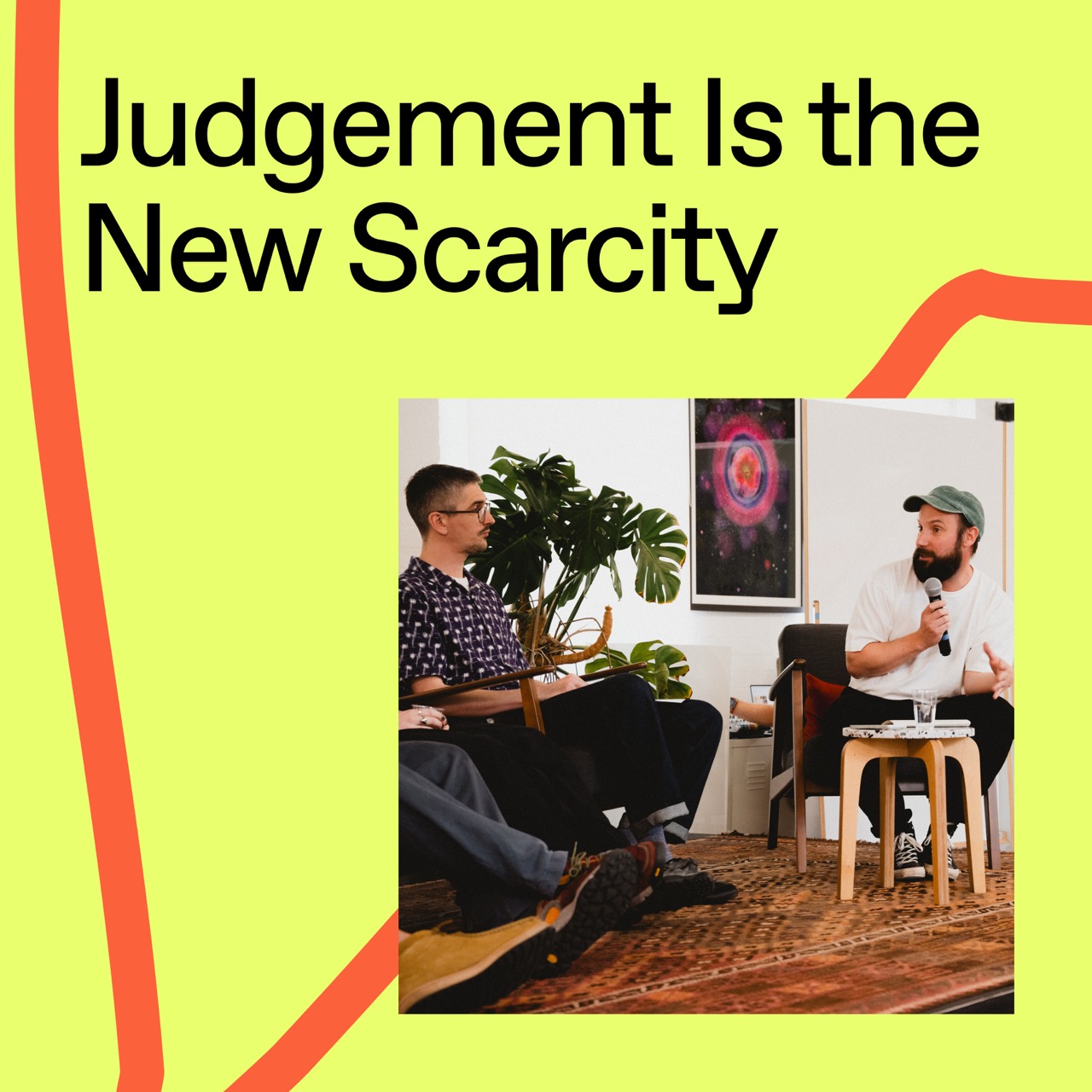
Reflections from Summer at the Wharf 2026
The OK COOL panel at Summer at the Wharf opened with a simple question: when was the last time you made a truly offline decision? Not a decision where you took the radical action of putting your phone down, but one genuinely uninformed by the internet at any point. A decision where nothing you'd seen, read, scrolled past or half-absorbed online had shaped the thought, the preference, or even the question you were asking yourself in the first place. The restaurant you "just felt like" going to, except you saw it on someone's story three weeks ago and forgot. The opinion you hold in earnest, except it crystallised in response to a comment on an Instagram post you no longer remember seeing. The audience couldn't think of one of these decisions. Neither could the panel.
That should be unsettling, a serious penny-drop moment, but to most of us in the room it came as no surprise. It’s just reality, at this point.
The impulse, from a distance, is to read this as cautionary, or something of a wake-up call: we are all too online, we must disconnect, and retreat to the safe offline shores we may find in a cabin in some rural heathland, 5G be damned.
But nobody in the room reached for that, because OK COOL’s exercise did more than reveal a known dependency. The question itself carries a loaded category error. There are no longer two worlds to distinguish between. There's one world, which we keep describing with a vocabulary built for two.
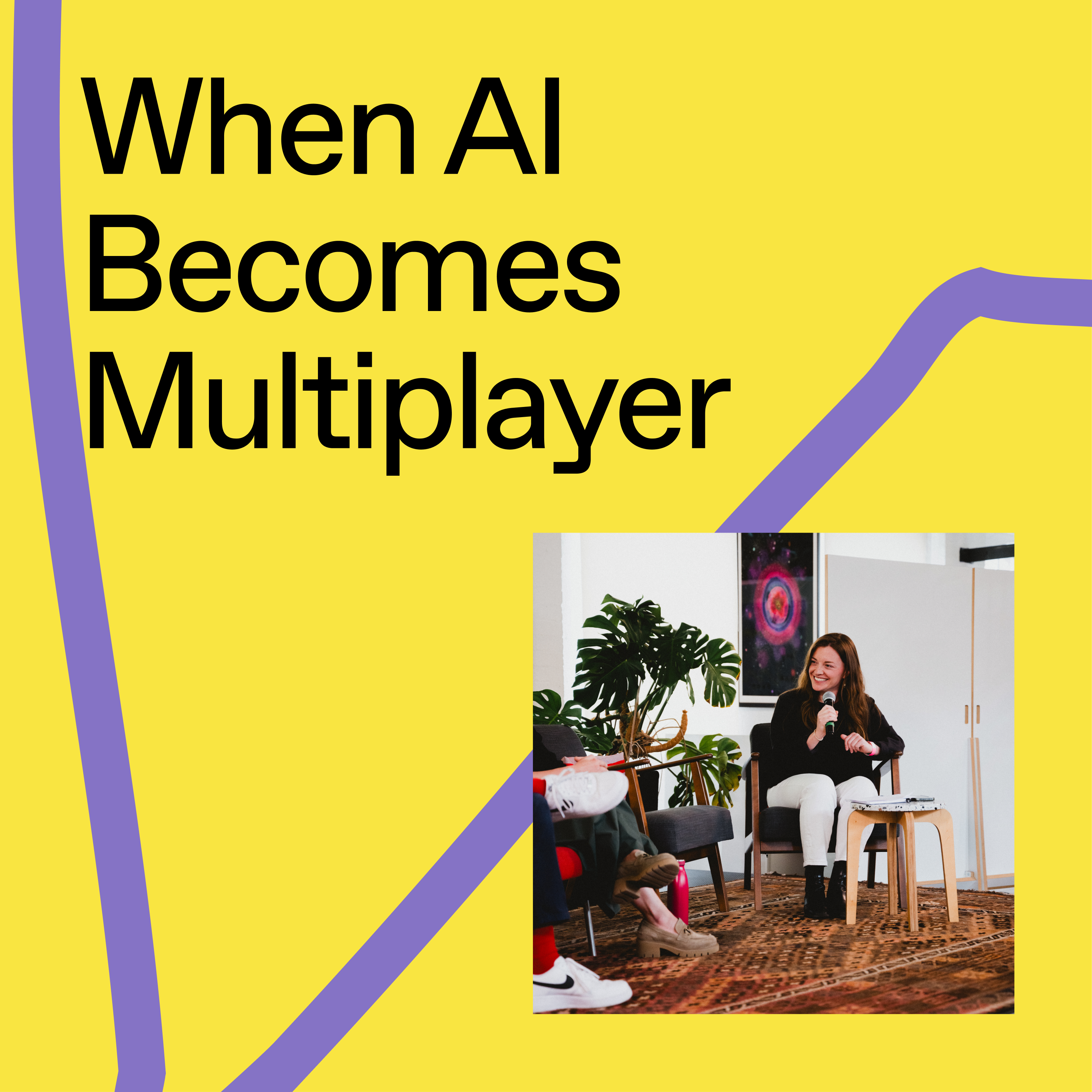
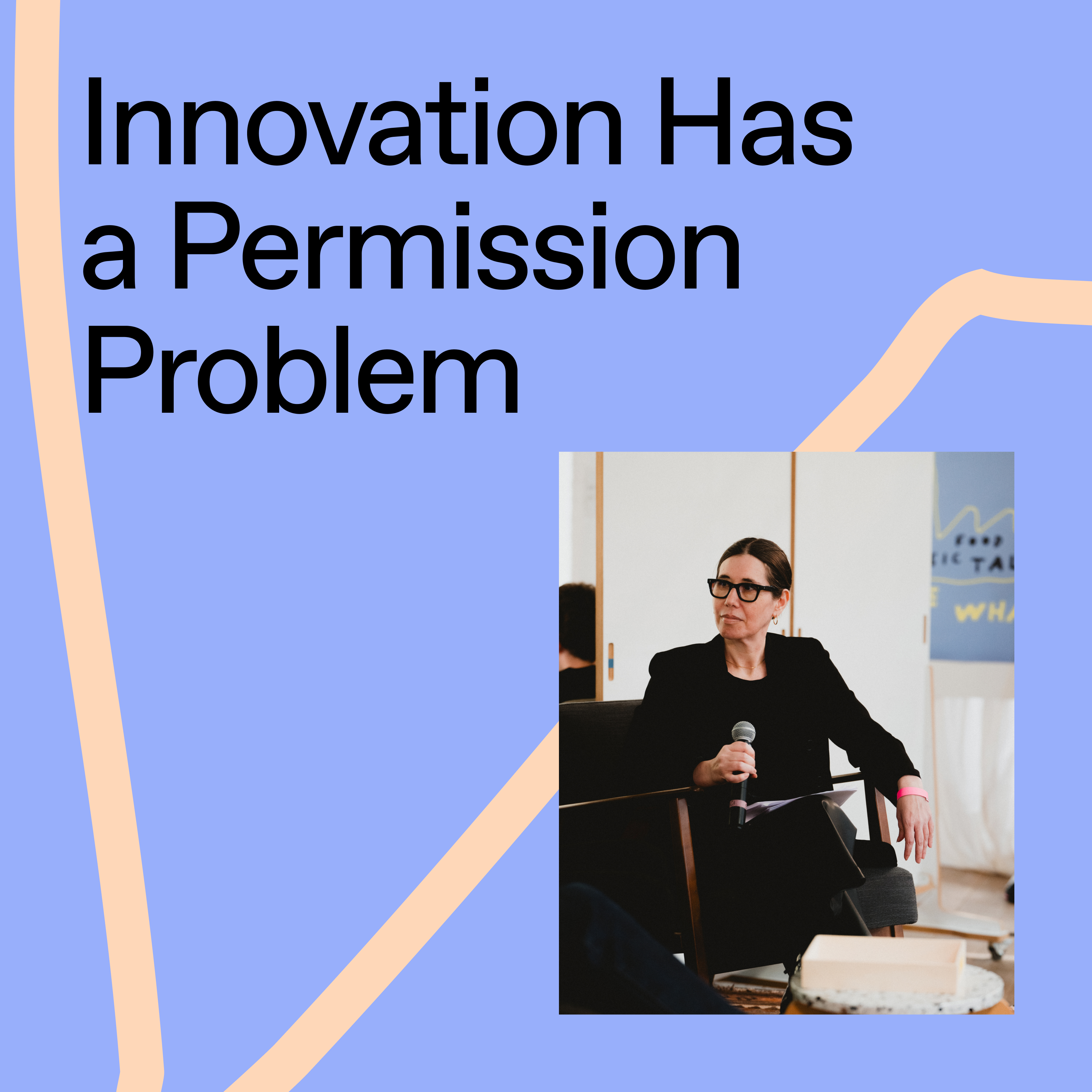
Summer at the Wharf ran two sessions back-to-back that made this uncomfortably vivid. OK COOL posed the question "What Even is Online Anymore?" through which they dissected how this distinction collapsed from every angle of modern life: identity, dating, culture, community. Then came a fireside conversation between the artist Times New Roadman and our very own Eliza Power. It was, without quite meaning to be, a case study of growing up in the wreckage. Between them, they covered a lot of ground. Almost none of it was reassuring, but at least they were both quite funny.
Every act is a speech act
Here is what Eliza Adedeji, one of OK COOL’s panellists, observed: nobody wants to be as performative as they are being.
That's an incredibly strange sentence on the first parse, as it implies people are performing against their will. Couldn’t they just not do that? The short answer: not really. The digital infrastructure we've built through social media enables a very narrow, illusory sense of self-expression, insofar as it demands a particular kind of it. Pronouns in bios, Hinge prompts answered in the right register, close friends and main stories as separate utterances to separate audiences. This is the architecture of social identity. The platforms require you to label, categorise and narrate yourself before anyone has had the chance to meet you. Add your favourite music, repost your favourite creators. Get political, or don’t - both are statements, after all. Existing offline never forced that hand. You could walk into a room and simply be there, unlabelled. So I’ve heard.
Eliza Power called it “reluctant performativity”; that very novel feeling that you are curating yourself for an audience that may not exist, using a format you didn't choose, in a language that was given to you. It is not quite alienation in the industrial sense. Nobody is being separated from their labour, and you can in fact revisit and revise your productions wherever, whenever. Instead, it is alienation where the gap between who you are and who you are performing has become invisible, because the performance never stops long enough to notice where one ends and the other begins.
Times New Roadman's entire body of work pokes at this. The Mob Kitchen chef walking around smoking a pastiche. The obligatory airport pint photograph posted to let the world know I’m travelling to one of the many exotic locations I frequent. The herds of Stone Island jackets, choreographing their formations lest the badge escape the angle of the camera. These are all online scripts performed in physical space - the signals broadcast, the feed made real. The satire of TNR’s art lands because the behaviour it targets is recognisable to literally everyone, and admitted by almost none.
Annie House leads strategy at OK COOL, and her insight complicates this dynamic. She argued that performance and authenticity are far less opposite, and far more coexistent, than we’re led to believe. People have always performed in social environments. Human social behaviour functions like a continuous performance where individuals adopt distinct roles, manage impressions, and seek group validation. The difference between the world today and the world this behaviour emerged from is that both performance and authenticity have been commodified. One of the most pressing challenges of branding today is finding the equilibrium between the performed and the genuine; the curated carousel and the shitpost private-story dump. The balance we all try to strike daily, consciously or not.
Memes are not what you think they are
The word "meme" is almost universally misunderstood, mostly because its popular meaning has swallowed its original one whole. Funnily enough, that’s the point.
Richard Dawkins coined it in The Selfish Gene in 1976, adapting the Greek mimeme, which roughly translates to "that which is imitated", and trimming it to a syllable that rhymed with "gene." The meme, in Dawkins's account, was a unit of cultural transmission: an idea, a tune, a catch-phrase, a fashion. A social gene, in other words, that earns its definition by surviving. The concept is abstract, evolutionary, and far wider than the specific usage of the word we use for any given ‘internet funny’.
What the internet did to the meme is mirrored in what it did to everything else. Transmission of ideas became instantaneous, their mutations rapid, and the competition for survival became brutally efficient. The meme became a picture with text on it because that format was the fittest replicator the digital environment had yet produced: quick-to-make, quicker-to-share jokes loaded with enough nuance and esotericism that they became at once both cultural commentaries and social bonds.
Times New Roadman described his art as "a vehicle for memes", not the other way around. The memes were the native medium of a chronically online generation. They were the points of social signal, or communication, and art was the frame he hung them in. He joked on the panel how he maintains relationships almost entirely through them. He informed us he had sent a meme to a university friend the other day but has not the slightest clue of what’s happening in the man's life. But they're in touch: the meme did the symbolic work that a phone call used to do, compressing reference, bond and affection into a single gesture that takes three seconds to send but can carry decades of shared context.
This is a genuine connection. But it is a connection unique to the social media age, and we don't have good-enough language to really understand what was lost - and gained - in the compression of it. There is something irreplaceable about co-presence. Being in the same room as other humans, noticing the same things, responding in real time to someone's face rather than to a screen. We’ve spent millennia perfecting this communication, and all of 15 years exploring how digital platforms are starting to reshape this. But there is also something new and real about a friendship sustained for years through nothing but shared images, in a language both people understand perfectly, and neither could explain to an outsider, if even to each other.
The pineapple problem
There was a TikTok referenced on the panel of a woman who analysed a thousand responses from men on dating apps to the question "what's your most controversial opinion?" 37% of them pineapple on pizza. Shock horror.
Eliza Power used this to make a broader point about what algorithms do to cultural diversity. A while back, she said, Made by Many hosted a speaker who argued that AI makes the average person better at creative pursuits but massively reduces the diversity of what is actually produced. The bell curve irons out idiosyncrasy, so that the genuinely idiosyncratic thins out. You end up with the phenomenon of a thousand micro-cultures that all use the same language and share the same references, mistaking minor variation for being worlds away.
Chris Etyitayo drew the same conclusion with a different example. In school, subcultures had steep barriers to entry. You couldn't just wear Osiris shoes unless you could actually skate. The shoes were a marker of participation, not just taste, and the culture was earned through a physical act. And the internet dissolved that barrier. You can buy Osiris on ASOS without ever touching a board, which is liberating and homogenising in the same motion. Access went up, and specificity went down, but the language for calling it out survived. What playgrounds used to call posing, the internet calls LARPing. It’s the same age-old accusation with a new vocabulary: you're performing a culture you don’t live.
The question is whether subcultures can exist without the conditions that created them. Who subcultures choose to permit, and how they qualify this. And who gets the final say? What originally defined subcultures - scarcity, locality, gatekeeping, time - sound like things nobody would desire to bring back. But they were the frictions that allowed genuinely distinct cultures to form, in their own time, on their own terms. Remove them all and you get infinite access, near-zero latency, and a world where the most controversial opinion anyone can summon is a topping choice.
The counterculture of friction
The pendulum is swinging.
Annie described being obsessed with what she called "internetified IRL": physical experiences that carry the energy, tone and history of online culture but deliberately reintroduce the physical space and body. Wrestling speed dating, which she'd seen in New York: you show up, you wrestle strangers for three minutes each, and by the end of the evening you've learned more about someone from how they move than a month of messaging could tell you. The online version of this interaction would smooth over all the violent, elbow-to-the-ribs magic of wrestling with a stranger, and it’s these versions of interactions that are starting to find themselves some resistance en masse.
Jacob Stratfold noted a similar pattern across music, film, and collecting. Once Spotify put every track in the world in one place, people went back to vinyl. Once Netflix offered infinite choice, people started building Criterion collections and taking pride in their Blu-ray shelves. Once dating apps optimised for volume, people discovered that efficiency was never really the barrier to forming deep connections with strangers. The cycle repeats: technology removes friction, friction turns out to have been where the meaning lived, and people go looking for it again.
This is not Luddism. Nobody at the Wharf was arguing we should log off for good, and the people making these arguments were doing so, it's worth noting, on a panel being live-captured by an AI. It is a juxtaposition we’re all trying to reckon with, and it’s something more interesting and harder to name than being anti-X and pro-Y. Gen Z is a generation that has to decide, having grown up with the social internet boom of the 2010s, which parts of physical life need protecting from it. The vinyl collection, therefore, can be a deliberate act of curation: an object, a shelf, a constraint. A connection to a family member’s music-listening ritual from decades ago. An audiophile’s belief system. Something that the algorithm can't ever replicate, and can’t ever improve on.
There is something else underneath this that the panel didn’t quite name, but definitely lived through the entire conversation. We are, by most accounts, deep inside a culture that is simultaneously hyper-referential, post-ironic and sincerely anxious about its own sincerity. Memes reference memes about memes. Irony has been layered so thick that earnestness, when it appears, reads as its own kind of performance. The pineapple-on-pizza answer is funny precisely because it is the most generic possible response to a question designed to reveal personality, delivered by someone who has absorbed enough internet to know what "controversial" maybe sounds like without having a single controversial thought. One does wonder what comes after this. Post-irony's post-irony is just a hall of mirrors. At some point, someone has to walk out of the building and - check this out - touch grass.
Where do we live?
Times New Roadman lives in Bournemouth. His gallery is Instagram. His relationships are maintained through memes. He's just put an offer in on a house. He paints his best work in oils, in a room, by hand, and his broadest audience will only ever encounter it on a screen, reshared on a story, probably uncredited.
Annie grew up on a farm three hours from Melbourne and found, through the internet, culture she would never have had access to otherwise. Chris had just started a TikTok. Eliza Power coaches her 38-year-old sister through Hinge. The panel's own audience was, at the time of participating, physically present in a room in a London wharf while simultaneously answering Mentimeter polls on their phones.
Community in 2026 is a Discord server and a supper club and a meme sent to someone you haven't spoken to in months. It is a group chat that replaces conversation and a conference panel that asks you to scan a QR code before it will start. It is a friend's Instagram story watched from a toilet. It is, very rarely, a room full of people with their phones in their pockets, actually talking.
Alienation is real. We swipe through human beings like products. We perform identities for invisible audiences. We speak in languages taught by algorithms and mistake it for our own. These costs are not distributed equally - a Pew survey found that 63% of American adults aged 18–29 say they are online "almost constantly”, which is, by any standard, a lot of life to spend inside the internet’s often psychotic infrastructure.
The upside is the access. The upside is the creativity. The upside is the connection that couldn't have existed before, between a boy in Bournemouth who fell into art and several hundred thousand people who send his work to each other in place of catching up. The internet, for all its social upheaval, didn't invent the tension between authenticity and performance, or between access and homogeneity, or between efficiency and meaning. It just made all three unbearably visible, and then removed the places where we could hide and pretend they didn't apply to us.
There's no such thing as offline. Arguably, there never was. The telephone, the letter, the newspaper all blurred the line between here and elsewhere, and the internet just finished the job. The interesting question was never really how to get back to the world before that. The question is how we can live well inside the one that replaced it.