Reflections from Summer at the Wharf 2026
There’s a small, deceptively enormous problem with AI, and no one’s talking about it.
Imagine you gave a household an AI assistant, one clever enough to manage the mental load of running that household. One that holds the to-do list on the fridge, the afterschool club timings, the family calendar. One that takes the information of many, and unifies it. Great, right? Not really.
That household list doesn’t exist in sight of everyone anymore. It becomes private. What used to be multiple points of information, retrievable across multiple shared surfaces, becomes unified information across private surfaces - phones, tablets, computers. The list doesn’t change, the tasks stay the same. But we don’t really share it anymore.
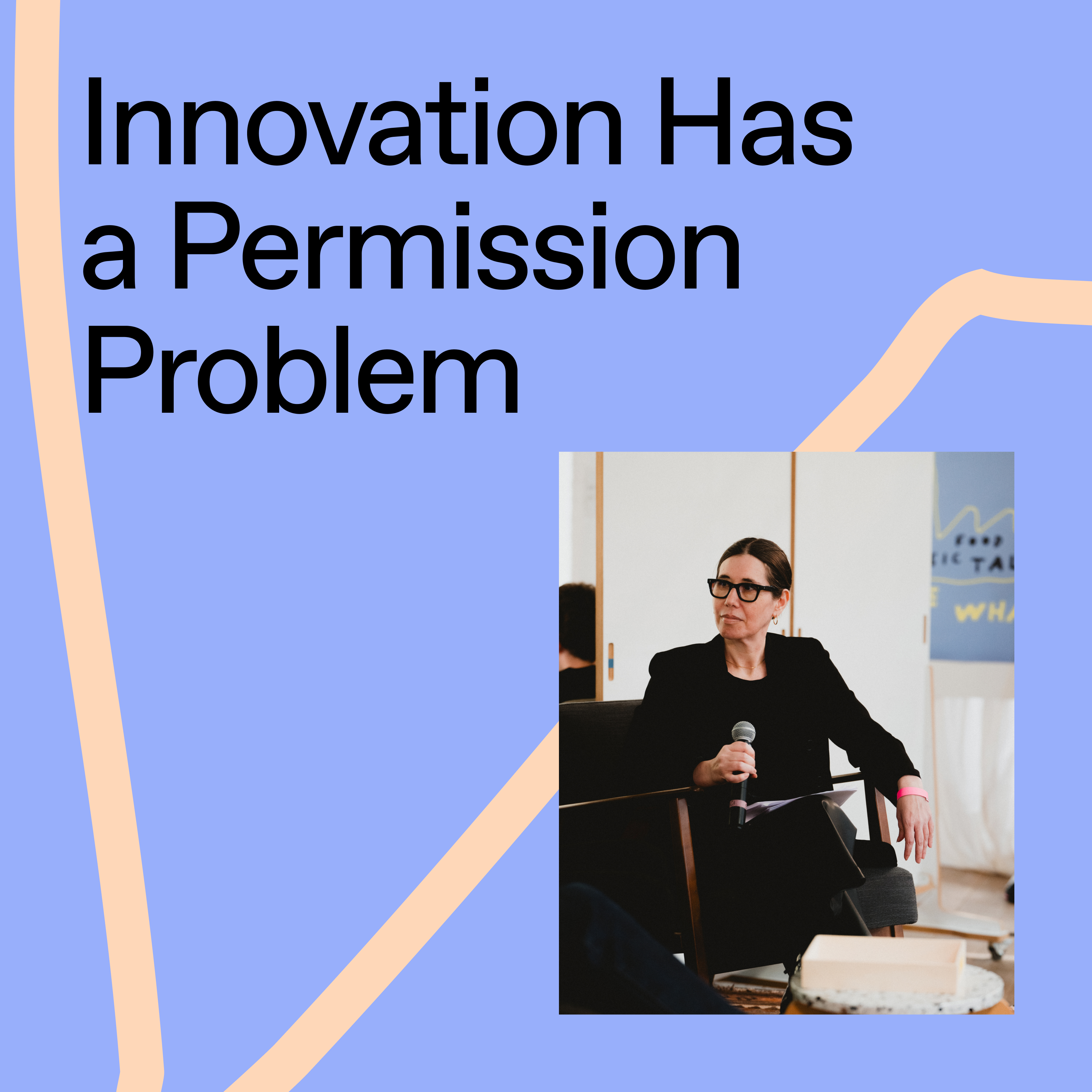
That's the story Erin Hackett of Stripe Partners opened with on the panel “My AI vs Our AI” at Summer at the Wharf this year where they brought to the stage what they called “Multiplayer AI”. Nobody designed this outcome on purpose. It felt like solving a problem. But it fell out of a less examined design decision: almost every AI product you've ever used was built for an audience of one, not for the interconnected lives we all lead.
Life isn’t single player
Individual accounts, private chats, password-protected phones, personal computers, and increasingly across our wrists and faces, the digital tools we’ve built as the infrastructure of the 21st century are designed around the individual. It makes sense; single users are, comparatively, the easiest thing in the world to design for. There' s only one set of preferences, one history, and one person to appeal to.
The problem is that real life is often messier than that. There are independent pursuits, of course, but we rarely function in isolation. Holidays require a (near painful) back and forth between partners and friends, we work with teams filled with people, we negotiate rent with flatmates (and again, near painfully with landlords). Life is structurally multiplayer, and the tools we’re building are unhelpfully single-player.
Spaces, not faces
Matt Webb, who's building a startup called Inanimate around putting people and AI agents in the same physical spaces, made an important distinction early on. Most of the industry's instinct is to put AI on your face: glasses, earbuds, pendants (regrettably). Matt instinctively went the other way–he's more interested in the room than the person in it, domestic spaces and home offices somewhere in the five-to-twelve-people range, where a shared AI has to serve a group rather than an individual.
The problems that surface there are uniquely durable ones, given that he'd already met them building software for small groups sharing a single AI, or a few AIs together. Permissions are an obvious example: if an AI knows something about you privately, is it allowed to bring that into a conversation with other people in the room? If so, how would you ever know if it had? And if it didn’t, how would this degrade the LLM, if it had to pretend to be missing information it knew it had? Could it ethically hint at this?
Conversational turn-taking is another problem: relatively trivial in a one-to-one exchange, and occasionally messy, but we’ve had hundreds of thousands of years to figure out how to navigate body language, microexpressions, and intonation–everything that goes beyond the words specifically being used. If we expect LLMs to work as conversation partners for groups of more than one, we must also expect the messy shortfalls that come when doing so.
The Trojan Horse
Sarah Gold, founder of Projects by If, reframed the topic at hand in a way that stuck with me, and it seems, the whole room. Something close to 90% of the design challenges her studio gets handed, she said, are relational at heart: not "solve this for one user" but "help these two or more people achieve something together." A caseworker and a citizen, a parent and a child, a teacher and a student, a boss and an employee. Multiplayer AI isn't introducing a new category of problem. It's a Trojan horse for challenges that have sat, half-solved, inside products and services for years, because the tools, eleven pre-AI, were never built to hold more than one person's needs at once.
That reframing matters because it means the interesting work here was never really about AI. It's about the relational design nobody quite got around to finishing the first time, now forced back onto the table because the tools have gotten good enough to expose the gap (if you read our last article on innovation’s permission problem, you’ll see it isn’t the only problem AI is bringing into the spotlight).
When forgetting is a good thing
Memory turned out to be where the conversation got the most fun (and complicated), largely because nobody had a clean answer. If a family shares a device, whose memory is it? Sarah described work looking at shared houses and smart-meter data: who becomes accountable for energy use nobody individually chose to record?
Matt's answer, when asked what a shared AI should remember, was almost contrarian: what if it remembered nothing at all? He described prototyping an "agentic lamp" that could turn on automatically for a call, and even change colour to flag an important one. The idea sounds harmless until someone else walks into the room and asks the lamp to tell them whether Matt's about to have a difficult conversation. Suddenly the lamp is exfiltrating information about you to whoever's nearby, and that violates every intuition you have about how a lamp is supposed to behave. His fix wasn't a cleverer permissions model, but to strip the memory out of the object entirely and carry it instead in something you hold, a totem that only works when you're actually present. Start with human intuition, in other words, and build the technology to match it, rather than importing the assumption that more memory is always better.
Sarah pushed the same idea further: memory isn't really a technical setting, it's a social object, something a group has to agree matters enough to keep. And forgetting has its own value that current design ignores completely. There's a world of difference between the mild social forgetting of "I know that face but not that name" and the harder deletion of "I don't remember this person at all," and neither maps cleanly onto how software currently thinks about data. Software's answer, so far, is to default to remembering everything, buried three menus deep in a settings page that's really there for the company, not for you. None of that was designed with a group in mind, and it shows the moment more than one person is meant to trust the same system.
There was a lovely, uncomfortable example of how this plays out commercially, not even involving AI. Netflix's old advertising line was that love is sharing your password, because they knew whole families were streaming off one account. Then someone in the commercial team worked out there was more money in drawing a hard line around what counted as a household, and did exactly that. Somebody going through a separation, living apart from the family home, simply stopped being part of the household overnight, by definition, for revenue reasons. Multiplayer was already there, quietly, in a product nobody thinks of as multiplayer at all. It just took a business need to force the definition into the open, and the person it hurt had no say in how the line got drawn.
Trust, power, and responsibility
Bring an AI into a group decision and, as Sarah put it, you shift where power sits, whether anyone intends to or not. The earliest large language models tended to amplify whoever used them most, or spoke loudest. Nothing says a system has to work that way. You could just as easily point one at pulling the quietest person in a room into the conversation instead. But someone has to decide to do that, deliberately, because the default won't do it for you.
The same shift shows up in how much you trust an answer. Ask a colleague with five years on a project a question, and you'll take their answer largely on trust, because you trust them. Ask a machine the same question and your response changes–you interrogate it more, or you don't, depending on context nobody's agreed on yet. Multiplayer AI forces a group to work out, explicitly, what a good-enough answer looks like, and how wrong they're all collectively willing to be. That used to be implicit–e all sort of trust certain people more than other based on context, relationship, a hunch you might have about their integrity. Now it has to be negotiated out loud and collectively.
Coordinator, not participant
One of the most useful examples is a distinction Matt drew from a prototype that failed. He'd built an AI meant to help a large group, twenty to a hundred people, find alignment: reading everyone's suggestions and proposing new ones people could rally around. It didn't work, and the reason is oddly poetic. The AI's suggestions belonged to nobody in the room. They weren't, in his phrase, “load-bearing”. Nobody had skin in them, so nobody rallied around them.
Contrast that with a different prototype he'd seen: an AI dropped into a group chat whose only job was to notice when someone should be pulled into the conversation, and suggest bringing them in. It didn't try to contribute content of its own, it just coordinated. And it worked, because it wasn't competing with anyone's voice, only connecting them. The lesson generalises further than group chats–the AI that tries to synthesise everyone’s thoughts or act as another peer in the room tends to fail quietly, while the AI that just helps the room organise itself tends to succeed. In short, getting information is loaded with questions of responsibility, trust, and power that AI can’t take on and that we seem to ignore.
Start with the human, not the tools
Erin closed the session by naming what had been true of every answer on the panel: none of it started with the technology. Successful multiplayer AI, she said, won't come from taking the single-player premise and bolting on more capability. It comes from starting with how people already navigate work and life with each other–which involves trust, forgetting, power, permission–and building the technology to fit that, rather than the other way round.
In essence, we built a generation of tools to make individuals faster. The harder and more interesting problem that no one has solved yet, is making groups think better together (as they always have done).
Life is multiplayer–and the tools need to catch up.